Oppa888

Dragon Tiger: Rules, Demo, Live Casino and Strategy Explained for Indian Players

«Before you place a single bet on Dragon Tiger, check the withdrawal rules and table terms. Dragon Tiger is a fast, two-card game of pure chance. Understanding the house edge on Tie bets and verifying payment limits matters far more than chasing short-term streaks.» — Nisha Rao, Casino and Betting India.

Author: Nisha Rao, iGaming analyst and live casino reviewer covering the Indian market (payment flows, licensing checks, live table audits) for Casino and Betting India. Last updated: June 2026. Payout schedules, table limits and tax rules are verified against provider rule sheets and regulator notifications at the date of publication.
Provider

Evolution

RTP

96.27%

Volatility

High

Min bet

0.10

Max win

50:1

Dragon Tiger Rules, Demo, Live Casino
Table of ContentCloseOpen
Dragon Tiger in 60 Seconds

Dragon Tiger in 60 Seconds

  • Dragon Tiger is a two-card comparison game: one card goes to Dragon, one to Tiger, and the higher rank wins (Ace = 1, King = 13). No third-card rules, no bust, no hand totals.
  • Main Dragon/Tiger bets pay 1:1 with a 3.73% house edge (96.27% RTP), the only statistically sensible wager at the table.
  • Tie bets pay 8:1, 10:1 or 11:1 depending on the operator. At 8:1 the RTP collapses to 67.23%; Suited Tie pays 50:1 at 86.02% RTP.
  • Roadmaps (Bead Road, Big Road, Big Eye Road, Small Road, Cockroach Pig) and the Predictor tool only visualise history. They carry zero predictive power over the next deal.
  • Lightning Dragon Tiger (Evolution) adds 2x to 8x suit multipliers, charges a 20% Lightning fee on every main bet, and can reach 1280:1 on a Suited Tie.
  • Indian players: expect 28% GST on chip purchases at land-based casinos and 30% TDS withholding on net winnings from online real-money gaming. Complete KYC early to avoid cashout delays.
  • Demo mode is free practice with virtual credits. Useful for pacing and discipline, though research shows simulated play can prime real-money wagering.
Who This Guide Is For and

Who This Guide Is For and What It Will Not Do

If you searched for Dragon Tiger because a live lobby banner caught your eye, this page is written for you. It explains the mechanics in plain English, prices every market honestly, and flags the parts that cost Indian players money: tie settlements, bonus contribution rates, KYC name mismatches, and tax withholding at withdrawal.

What this guide will not do: promise profit. There is no winning system here, because the maths does not allow one. What you will get is a clear view of the odds, the fees, and the checks worth running before your first deposit. Read the risk sections twice, the payout tables once.

What Dragon Tiger Is and How the Game Works

Dragon Tiger is a minimalist two-card casino comparison game where the highest single card dealt decides the winning side in each round. It began as a fast-paced baccarat variant in East Asian casinos, and it still works the same way: two positions, Dragon and Tiger, face each other using standard multi-deck shoes.

«Dragon Tiger is particularly popular in Cambodia, Vietnam, Thailand and Macau; Pragmatic Play positions it as "the most popular card game in South East Asia".» — Pragmatic Play Dragon Tiger Live product documentation (2020). https://www.pragmaticplaylive.net/

Vendor documentation from Evolution describes the title as "a two-card version of Baccarat" whose popularity is "growing around the world", which explains why the same felt layout now appears in European, Latin American and Indian-facing live lobbies. In some provider catalogues the game is also listed under the alternative names "Same-Suit Tie" or "Suited Tie", a nod to its signature high-payout side bet. You may also see it filed as tiger dragon in a poorly translated lobby menu. Same game.

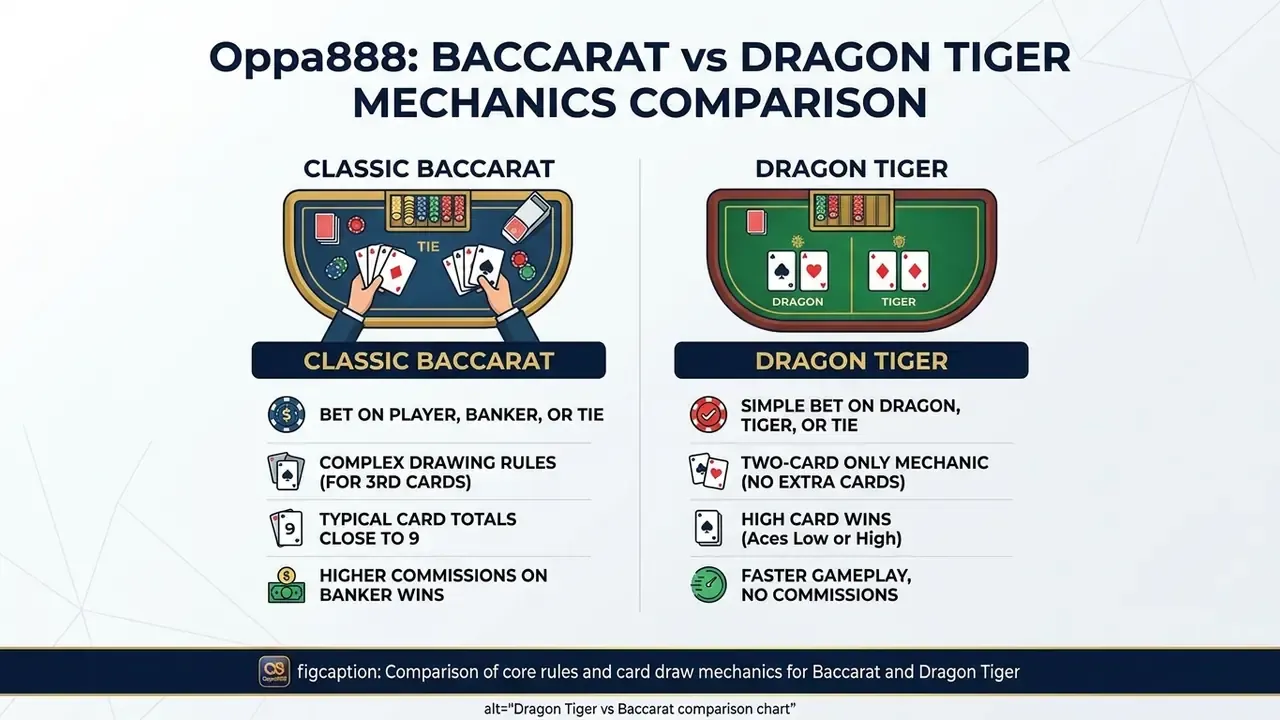
Dragon Tiger vs Baccarat comparison chart
Dragon Tiger: one card per side instead of complex point scoring
Dragon and Tiger Which Cards Are

Dragon and Tiger: Which Cards Are Compared in a Round

In a Dragon Tiger game, the dealer deals exactly one face-up card to the Dragon position and one face-up card to the Tiger position. Card rank runs strictly from Ace (lowest, 1 point) to King (highest, 13 points). Suits have no bearing on the outcome of the main round.

The core objective in every game played is predicting which side receives the higher-ranking card:

  • Ace:1 point
  • 2 through 10:Face value (2 to 10 points)
  • Jack:11 points
  • Queen:12 points
  • King:13 points

Because only two cards are drawn per round, there are no extra card rules, no hand point additions, and no "bust" mechanics. The side holding the single highest card wins instantly, in line with the regulatory standards published by the Gambling Regulatory Authority of Singapore (GRA) Dragon Tiger Rules.

That simplicity is the appeal. It is also the trap: a round that resolves in seconds invites far more hands per hour than most players plan for.

Which Outcomes Are Available to the

Which Outcomes Are Available to the Player

Players can wager on three primary outcomes in every hand: Dragon win, Tiger win, or a Tie between both positions. Secondary options such as Big/Small, Odd/Even, Red/Black or specific-suit bets on individual cards appear depending on the software provider. The exact market list per vendor is documented in the comparison table further below.

The primary betting sectors work like this:

  • Dragon Bet:Wins if the card dealt to the Dragon position outranks the Tiger card.
  • Tiger Bet:Wins if the card dealt to the Tiger position outranks the Dragon card.
  • Tie Bet:Wins if both cards share the exact same numeric rank (for example, two 8s).
  • Suited Tie Bet:Wins only when both cards match in rank and suit (for example, two 8s of hearts).

Dragon Tiger Rules: Betting Rules and Round Flow

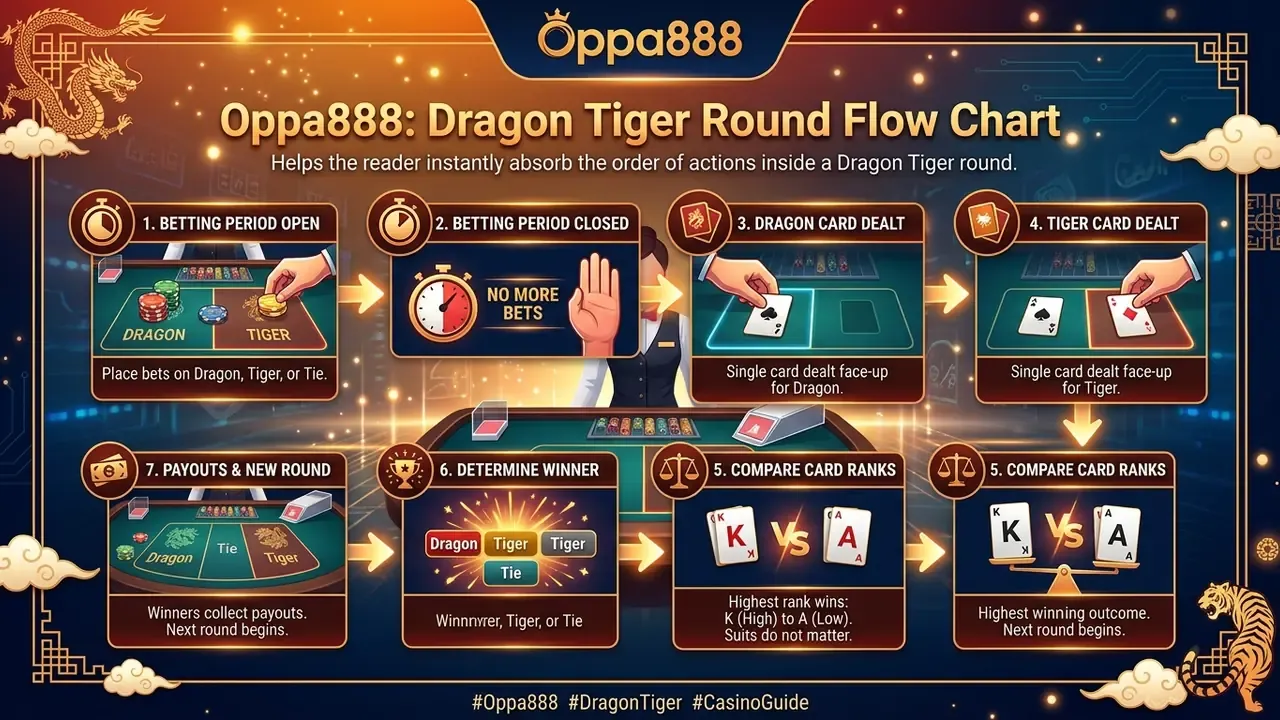
Dragon Tiger rules require every bet to be locked in before the dealer draws a card from the physical or virtual shoe. Once the betting timer expires, the dealer deals two face-up cards, compares their rank, announces the winning outcome, and settles all wagers automatically. No player decision follows the deal. That is the whole game.

Dragon Tiger round sequence diagram
Step-by-step round sequence from bet to payout
Dragon Tiger Round Flow. 1. Bet

Dragon Tiger Round Flow

  1. Bet Placement: The player selects chip values and places a bet on Dragon, Tiger, Tie, or an available side bet within the posted table limits. The dealer opens the round with the standard announcement "Place your bets, please".
  2. Betting Closed: The electronic timer reaches zero and the dealer announces "No more bets", locking all table positions.
  3. Card Deal: The dealer draws the first face-up card to the Dragon spot, then the second face-up card to the Tiger spot, from an 8-deck shoe.
  4. Rank Comparison: Ranks are compared (Ace = 1, King = 13). Suits are ignored for main outcomes.
  5. Round Settlement: Winning bets pay out immediately; losing chips are collected. If a Tie occurs, main Dragon/Tiger bets lose 50% or push, depending on platform rules.
How to Place a Bet Before

How to Place a Bet Before the Cards Are Revealed

A player selects a chip denomination and places it on the chosen table sector (Dragon, Tiger, or Tie) during the active 10 to 15 second betting window. Evolution's Lightning tables run a 12-second betting phase. Wagers cannot be added, modified, or cancelled once the countdown ends and the dealer starts drawing cards.

For Indian users on mobile, table layouts display clear minimum and maximum bet indicators in Indian Rupees (INR). Before placing a bet, confirm your wallet balance covers the full stake. In a recent editorial audit of Indian payment flows for live casino tables, published in our Casino and Betting India iGaming guide, our team assessed UPI deposit integration across 15 major operators. Clear table limit displays measurably reduced accidental bet sizing on low-bandwidth mobile connections.

One practical note from that audit. Tie and Suited Tie sectors can normally be backed without a main Dragon or Tiger bet, but placing chips on Dragon and Tiger at the same time is treated as void play by most operators, and such wins are frequently disqualified. Read the table terms before you try to hedge both sides. It rarely ends the way players expect.

How the Dealer Determines the Dragon

How the Dealer Determines the Dragon Tiger Result

The dealer settles the round by comparing the numeric rank of the two face-up cards on the felt. The higher rank wins 1:1. Identical ranks trigger a Tie, where main bets either lose half their stake or are returned in full, depending on the casino's rule sheet.

In standard multi-deck play (6 to 8 decks), Dragon and Tiger hold symmetrical odds of 46.27% each, with Ties landing in roughly 7.5% of deals. Correction worth flagging: earlier editions of this guide cited 7.46%, but verified combinatorial modelling gives a slightly higher figure. Both values come from the mathematical work published by Wizard of Odds Dragon Tiger Analysis.

«Of 86,320 possible ordered two-card outcomes from an eight-deck shoe, 6,488 produce a tie, a probability of roughly 7.51%.» — Wizard of Odds, Dragon Tiger Analysis. https://wizardofodds.com/games/dragon-tiger/

Shoe and cut card specification (for advanced players). Live studios use eight-deck shoes of 52 cards each, so 416 cards in total. The dealer inserts a cut card roughly two decks from the bottom, around the 312th card. When the cut card is reached, the shoe is retired and replaced with a freshly shuffled one. That is precisely why any practical card-counting advantage in Dragon Tiger is squeezed into a very narrow window. Some studios reshuffle when a single deck remains instead of two, so penetration differs slightly by provider.

How to Read Dragon Tiger Roadmaps

How to Read Dragon Tiger Roadmaps

Live tables from Evolution, Pragmatic Play, Playtech and On-Air display electronic scorecards of previous deals, known collectively as Roadmaps. They record the current shoe's history and help players orient themselves in the interface. They do not change the probability of any future round.
  • Bead Road (Bead Plate):A chronological grid read top to bottom, left to right. Red cells mark Dragon wins, blue or yellow cells mark Tiger wins (colour coding varies by provider), green cells mark Ties. On Lightning tables, rounds that received a multiplier are highlighted separately.
  • Big Road:The primary trend grid. Consecutive wins by the same side stack downward in one column; when the winning side changes, a new column starts to the right. Ties are marked with a slash across the affected cell.
  • Derived roads (Big Eye Road, Small Road, Cockroach Pig):These show no outcomes at all. They translate the symmetry and repetition patterns of the Big Road into red and blue markers, comparing columns at different offsets (one column back, two back, three back).
  • Shoe summary panel:Above the scorecards, most tables show the total hands dealt in the current shoe plus separate counters for Dragon, Tiger and Tie results.
  • Predictor function:The most engaging tool in the interface. It previews how the derived roads would look if Dragon wins the next round versus if Tiger wins, letting pattern players see the branching in advance.

Reality check: Roadmaps are a record-keeping and entertainment feature. Every deal comes from a shuffled shoe with independent distribution, so no roadmap configuration alters the 46.27% / 46.27% / ~7.5% split of the next round. What roadmaps do show reliably is the shoe's progress toward the cut card, and how many hands you have already played. Use them as a session-length signal, not a forecast.

Dragon Tiger Online: Demo Version and Live Dealer

Dragon Tiger online arrives in two distinct formats: software-driven RNG simulators, including free demo versions, and real-time live casino tables hosted by physical dealers. Knowing the difference between virtual demo play and a live dealer video stream helps you pick the right format before money is involved.

Dragon Tiger Demo Playing Without Real

Dragon Tiger Demo: Playing Without Real Money

A dragon tiger demo is a free-to-play software simulation using virtual credits, letting you practise the rules and interface with zero financial risk. Demo modes mirror the rules and mathematical model of real-money RNG games, but virtual credits cannot be converted into cash, moved to a casino balance, or withdrawn.

Demo play helps beginners learn card ranks, round timing and table layout without balance pressure. Worth knowing: Evolution's live Dragon Tiger tables do not offer practice chips. Free play exists only in RNG and "First Person" formats, and the First Person client includes a GO LIVE button that drops you straight onto the real-money live table. One click. That bridge is exactly where discipline matters most.

Population-level research on simulated gambling published by Fiedler et al. (2024) in the Journal of Gambling Studies shows demo casino play can act as a psychological primer for real-money wagering, which is why self-discipline still applies even with practice chips.

«54% of real-money gamblers had also engaged in simulated gambling; 33% of those combining both formats showed signs of gambling disorder.» — Fiedler et al. (2024), Journal of Gambling Studies, representative sample of 46,136 German internet users. https://link.springer.com/journal/10899

Dragon Tiger Live Dealer Playing With

Dragon Tiger Live Dealer: Playing With a Video Dealer

Dragon Tiger live dealer games stream high-definition video from dedicated studios, with physical cards, real 8-deck shoes, and human dealers running the table. Live casino versions combine real dealing with a digital betting interface, digital roadmaps, and dealer chat.

Major studios such as Evolution Gaming, Pragmatic Play Live, Playtech, On-Air Entertainment, Ezugi and XPG stream live dragon tiger casino tables around the clock, often with native-language dealers for Hindi-speaking audiences in India. Vivo Gaming markets fully chroma-key customisable Dragon Tiger tables with dealer support in more than 35 languages, which is why the same game surfaces under different branding across operators.

Live tables move at roughly 25 seconds per round, so 30 to 40 hands per hour. RNG software can clear 120 to 150 hands per hour.

«Live Dragon Tiger tables process roughly 30 to 40 hands per hour due to streaming overhead and dealer actions, versus 120 to 150 deals per hour on RNG software.» — Betting Data Lab, Dragon Tiger operator-level analytics. https://bettingdatalab.com/

That speed gap has a direct financial consequence. At a fixed 3.73% house edge, an RNG session burns through theoretical expected loss three to four times faster than a live table at identical stakes. Same maths, different clock.

Feature / FormatDragon Tiger DemoOnline RNG (Real Money)Live Dealer Live Casino
Real Money StakeNo (Virtual Credits)Yes (INR Balance)Yes (INR Balance)
Dealer TypeSoftware / AlgorithmicRandom Number GeneratorReal Human Dealer
Video StreamNone (3D Animation)None (3D Animation)HD Video Live Stream
Dealing SpeedInstant / Self-PacedFast (120 to 150 hands/hr)Moderate (30 to 40 hands/hr)
Main Bet RTP96.27% (Simulated)96.27%96.27%
Roadmaps / StatisticsBasic result historyResult history panelFull roadmap suite + Predictor
Card CountingImpossible (Reshuffled)Impossible (Reshuffled)Theoretical (Physical Shoe)

Summary: Demo mode gives you a risk-free environment for learning mechanics. Online RNG prioritises speed and flexible limits, while a live dealer table offers visual transparency and a physical shoe. Main bet RTP stays at 96.27% across all legitimate licensed formats, so format choice is about pace and comfort, not better odds.

Bets, Tie and Payouts in a Dragon Tiger Casino

In a dragon tiger casino, payouts and house edge swing sharply depending on whether you take a main wager or a high-variance side bet such as Tie or Suited Tie. The house edge on standard Dragon or Tiger sits at a competitive 3.73%. Tie wagers carry a far heavier mathematical penalty.

«At 8:1 odds and a tie probability of about 7.5%, the Tie bet returns just 67.23%, one of the worst single wagers on any casino floor.» — Wizard of Odds, Dragon Tiger Analysis (eight-deck shoe). https://wizardofodds.com/games/dragon-tiger/

How the Tie Bet Differs From Dragon and Tiger Bets

A Tie bet wins only when both cards match in exact rank, paying a higher multiplier (8:1, 10:1 or 11:1) in exchange for a drastically higher house edge. Main bets win nearly half the time; a Tie lands in about 7.5% of hands. That gap is the entire story.

Bet TypeWin ConditionStandard PayoutHouse Edge (%)Theoretical RTP (%)
DragonDragon card rank > Tiger card1:13.73%96.27%
TigerTiger card rank > Dragon card1:13.73%96.27%
Tie (Standard 8:1)Dragon rank = Tiger rank8:132.77%67.23%
Tie (10:1 tables)Dragon rank = Tiger rank10:117.83%82.17%
Tie (Evolution 11:1)Dragon rank = Tiger rank11:110.36%89.64%
Suited TieDragon rank & suit = Tiger rank & suit50:113.98%86.02%

Payout Explanation: Main bets pay even money (1:1). When a Tie occurs, standard table rules return 50% of your main Dragon/Tiger stake and forfeit the rest; a minority of rule sheets treat the tie as a full push. Higher multipliers on Tie and Suited Tie are offset by much lower return-to-player figures. Note too that some local operators publish non-standard tie settlements. Deltin Casino, for instance, advertises a 10x tie payout alongside the 50% main-bet return, which is another reason to read the specific table rules rather than a generic guide.

Side Bets and Provider Payout Comparison

Beyond the three core outcomes, Dragon Tiger tables carry a variable menu of side bets, and availability depends entirely on the software vendor. Playtech and Pragmatic Play run the widest markets; Evolution's classic table is deliberately lean; Ezugi and XPG sit in between with a lower 8:1 Tie.

Bet TypeWin ConditionStandard PayoutEvolutionPragmatic PlayPlaytechEzugi / XPGOn-Air
Dragon / TigerChosen side holds the higher card1:11:11:11:11:11:1
TieBoth cards share the same rank8:1 to 11:111:111:110:18:111:1
Suited Tie (One Suit Tie)Rank and suit match on both cards50:150:150:150:1N/AN/A
Big BetCard is 8, 9, 10, J, Q or K (7 loses)1:1N/A1:11:1N/A1:1
Small BetCard is A, 2, 3, 4, 5 or 6 (7 loses)1:1N/A1:11:1N/A1:1
Odd / EvenCard rank parity on the chosen side1:1N/A1:11:11:11:1
Suit BetExact suit called (Hearts / Diamonds / Spades / Clubs)3:1N/A3:13:1N/AN/A
Red / BlackColour of the chosen side's card1:1N/AN/A1:11:1N/A

Reading the table: the widest side-bet menu is not automatically the best value. Suit bets at 3:1 look tempting, but a single suit appears on roughly one card in four, so the true odds sit near 3:1 minus the operator margin. Across every provider the conclusion is the same: the 1:1 Dragon/Tiger market remains the lowest-edge wager available among these casino games.

Lightning Dragon Tiger Multipliers, Fees and

Lightning Dragon Tiger: Multipliers, Fees and Adjusted Payouts

Alongside classic tables, live lobbies now host multiplier variants. The most prominent is Lightning Dragon Tiger from Evolution, which keeps the base rules identical and layers random suit multipliers on top.
  • The 20% Lightning fee:Before each round, a charge equal to 20% of your total main bet is deducted from your balance. It is a cost of entry, not part of the stake, and it is never returned.
  • Random multipliers:Once betting closes, one of the four suits (Hearts, Diamonds, Spades or Clubs) is randomly assigned a multiplier between 2x and 8x.
  • Multiplied payouts:If the winning card carries the Lightning suit, that hand's payout is multiplied. Dragon and Tiger wins therefore pay between 1:1 and 8:1.
  • Double multipliers on Suited Tie:Because a Suited Tie involves two matching cards, both multipliers can apply. With two 8x multipliers, the base 20:1 Suited Tie payout escalates to a maximum of 1280:1.
  • Adjusted base payouts:To fund the multipliers, base Tie payouts drop to 6.5:1 (rising to 52:1 with a multiplier), and Suited Tie falls from 50:1 to a base 20:1. Published RTPs for the Lightning version are 96.97% on Dragon/Tiger, 91.26% on Tie and 82.93% on Suited Tie.
  • No side bets:Lightning removes Big/Small, Odd/Even and suit markets entirely. The trade-off is straightforward: multiplier upside on the main bet versus market variety and higher base Tie odds on classic tables.

E-E-A-T Rule Verification Note: Payout schedules, Tie refund policies (50% loss versus full push), Lightning fees and table minimums are not uniform across platforms. Open the table help menu (the ? icon) inside your active game client and confirm exact payout odds and house rules before wagering real money. Regulated rule sheets published by authorities such as the GRA Singapore define one standard; individual operator terms may legally differ.

Dragon Tiger Strategy How to Approach

Dragon Tiger Strategy: How to Approach Betting With Awareness

A mathematically sound dragon tiger strategy comes down to two things: strict bankroll management and sticking to low-house-edge main bets. It has nothing to do with predicting card sequences. Every deal is an independent probability event, so no progression system and no pattern-tracking roadmap can erase the built-in edge.

[❓ QUIZ: 3 questions to check your understanding of Dragon Tiger risk. Caption: "Check your readiness before funding an account".]
Purpose: Interactive self-assessment covering bankroll rules and the independence of rounds.
Semantics: section with form role; aria-labels; text description of results.

Why Past Results Do Not Guarantee a Win

Deal histories shown on digital roadmaps (Big Road, Bead Plate and the rest) have zero mathematical influence on future draws. Concluding that Tiger is "due" because Dragon has won five hands in a row is a textbook cognitive trap, the Gambler's Fallacy.

From a probability standpoint, drawing cards from a multi-deck shoe follows independent distribution rules:

$$P(A_{n+1} \mid A_1, A_2, \dots, A_n) = P(A_{n+1})$$

«Players systematically expect the opposite outcome to be "due" after a streak, the classic gambler's fallacy, documented in casino roulette studies and coin-flip experiments.» — Croson & Sundali, gambler's fallacy research in casino settings; probability context via Wizard of Odds. https://wizardofodds.com/games/dragon-tiger/

Even mid-streak, the probability of Dragon

Even mid-streak, the probability of Dragon or Tiger taking the very next hand stays fixed at about 46.27% (excluding Tie). Chasing patterns or doubling stakes with a Martingale during a losing run only accelerates the risk of wiping out your session bankroll.

A concrete Martingale example. With a ₹2,000 session balance and a ₹100 opening stake, the progression runs ₹100, ₹200, ₹400, ₹800, and the fifth step of ₹1,600 already exceeds your remaining funds. So a five-hand losing streak, which happens regularly in a game where each side wins under 47% of hands, ends the session. Doubling never touches the 3.73% edge. It only compresses the time until ruin.

Practical Bankroll Framework for Indian Players

ParameterConservative settingWhy it matters
Session bankroll₹5,000 (funds you can afford to lose)Defines the total exposure ceiling
Flat stake per hand₹100 (2% of balance)Survives long variance swings
Stop-loss₹1,500 (30% of bankroll)Prevents chasing losses
Stop-win₹1,000 (20% of bankroll)Locks in a positive session
Session time limit45 minutesCounters fatigue-driven decisions
Bet selectionDragon or Tiger only (1:1)Lowest house edge available

Set these numbers before you open the table, not during a losing run. Decisions made mid-session are almost always worse.

How to Use Demo Mode to

How to Use Demo Mode to Test Your Strategy

Use the dragon tiger demo format for one purpose only: testing staking discipline. Flat betting (a fixed 1% to 2% of balance per hand) against percentage allocation, with no personal capital at risk. Demo practice also lets you feel a real loss streak and set honest stop-loss boundaries before money is involved.

To run a useful demo test:

  1. Set a virtual starting session budget, for example 5,000 virtual INR.
  2. Apply a strict flat-bet rule of 100 INR per hand across 50 simulated rounds.
  3. Track how deep your drawdown goes during consecutive losing rounds.
  4. Repeat the same 50 rounds using percentage staking (1% to 3% of the current balance) and compare the deepest drawdown of each method.
  5. Confirm for yourself that no progression yields a positive long-term return against the 3.73% main house edge.

«Simulations show card counting can reduce the house edge from 3.73% to roughly 2.1%, but favourable situations appear in only 3.5% to 16% of hands under strict bankroll requirements.» — Betting Data Lab, "Dragon Tiger Card Counting with 8-Deck Shoe: Mathematical Analysis and Reality Check" (2024). https://bettingdatalab.com/

Because the cut card retires the shoe around the 312th card, those rare favourable windows are short-lived. In RNG and demo formats they do not exist at all, since the virtual shoe reshuffles after every round.

General Information Notice: This material is general in nature and does not replace professional advice. Real-money gambling carries financial risk and is available only to adults in accordance with the laws of your jurisdiction.

Responsible Gambling Disclaimer: Real-money dragon tiger play involves significant financial risk. No betting strategy, pattern system or software tool can guarantee winnings or remove the house edge. Casino games should be treated strictly as paid entertainment, never as a source of income. Real-money gaming is restricted to legal adults (18+ or 21+ depending on local jurisdiction). Set strict deposit limits and never gamble with money needed for essential living expenses. If gambling stops feeling like entertainment, contact support resources such as GambleAware or GamCare.

How to Access Dragon Tiger in an Online Casino

Getting to Dragon Tiger involves three steps: choosing a verified, licensed platform, picking demo or real-money mode, and setting up account controls first. For Indian users, checking payment compatibility with UPI and NetBanking belongs before registration, not after.

How to Start With the Dragon

How to Start With the Dragon Tiger Demo

To launch a free demo, open a licensed operator lobby or a provider showcase, search for "Dragon Tiger" in the RNG table games category, and select "Demo" or "Practice". Free play opens directly in your desktop or mobile browser, with no account verification and no deposit.

Step-by-step demo launch:

  • Navigate to the casino catalogue or the software provider page.
  • Filter by category, Table Games or Card Games, or search by provider name (for example "Evolution", "Pragmatic Play").
  • Open Dragon Tiger RNG or First Person Dragon Tiger and tap Play for Fun / Demo.
  • Confirm the virtual credits load correctly in the balance display.
  • Leave the GO LIVE button alone until you have consciously decided to move to real-money stakes.
Legal Status, GST and TDS What

Before funding an account, understand three separate layers of regulation, because the game interface handles none of them for you.

1. Legal framework. Gambling in India is governed mainly by the Public Gambling Act of 1867 together with state-level legislation, so the position differs by state. Sikkim, Goa, Daman and Meghalaya operate their own licensing regimes for casinos or online gaming, while several states have imposed explicit prohibitions on real-money online gaming. Check your own state's current position before you deposit. A game being technically accessible does not make it lawful where you live.

2. GST on land-based chip purchases.

3. TDS on online winnings. For online real-money gaming, Indian income tax rules provide for withholding on net winnings, commonly applied at 30%, deducted at source either at withdrawal or at the end of the financial year. There is no minimum threshold exemption and no deduction of expenses. In practice, the amount reaching your bank account can be materially lower than your on-screen balance, and you need to be able to reconcile the two. Keep transaction statements for every deposit and every withdrawal.

Moving to Real-Money Dragon Tiger in a Casino

To move to real-money dragon tiger play, register with a licensed operator, complete KYC identity verification, deposit through a secure gateway (UPI, Paytm, NetBanking), then open the Live Casino lobby and pick a table inside your budget.

Pre-Deposit Checklist for Indian Players. 1

Pre-Deposit Checklist for Indian Players

  1. Licensing Verification: Check the footer for valid licensing details (Curacao, MGA and similar) and active registration numbers, then cross-check the licence number and legal entity name against the regulator's public register.
  2. Payment Friction Check: Confirm that INR deposits and withdrawals support direct UPI or NetBanking, with clear transaction limits and no hidden fees.
  3. KYC Requirements: Prepare government-issued ID (Aadhaar or PAN) and verify early to avoid cashout delays. Make sure the account name matches the bank or UPI ID exactly. Mismatched names are the single most common cause of blocked withdrawals.
  4. Table Limit Selection: Open the Live Casino section and choose a Dragon Tiger table whose minimum stake fits your pre-set session budget, for example a ₹50 to ₹10,000 table.
  5. Bonus Terms Check: Confirm the wagering contribution rate for Dragon Tiger. Live card games often contribute only 5% to 10%, sometimes 0%, and many bonus terms explicitly void low-risk or opposite-side betting.
  6. Responsible Tools: Switch on daily or weekly deposit limits in account settings before your first real-money wager.
Red Flags How to Spot an

Red Flags: How to Spot an Unsafe Dragon Tiger Platform

  • No verifiable licence. A logo image in the footer is not proof. If the licence number does not resolve on the regulator's own register, treat the site as unlicensed.
  • Unbranded or looping "live" streams. Legitimate live tables carry provider branding (Evolution, Pragmatic Play, Playtech, Ezugi, On-Air, Vivo), a visible shoe, a round ID and a working history log. Scripted animation presented as live video is a hard stop.
  • Missing rules and payout menus. If the ? panel does not disclose exact Tie payouts, the tie-settlement rule and table limits, you cannot verify what you are betting into.
  • Withdrawal delays beyond 48 hours on a fully KYC-verified account, or repeated requests for the same documents.
  • Bonus traps: wagering requirements above 40x, maximum-win caps buried in the terms, or a Dragon Tiger contribution rate that quietly makes the bonus unclearable at your chosen table.
  • No responsible gambling tooling. Missing deposit limits, self-exclusion or reality checks points to an operator outside meaningful oversight.
  • Payments routed through personal accounts or third-party wallets instead of a corporate gateway.
Glossary of Dragon Tiger Terms

Glossary of Dragon Tiger Terms

  • Shoe:The dealing box holding the shuffled decks, eight 52-card decks (416 cards) at most live Dragon Tiger tables.
  • Cut card:A plastic marker inserted roughly two decks from the bottom of the shoe; reaching it triggers a shoe replacement.
  • Push:A neutral settlement where the stake is returned rather than won or lost. Some tables push main bets on a Tie; most return only 50%.
  • Suited Tie:A tie where both cards match in rank and suit, the highest-paying standard market (50:1 classic, up to 1280:1 in Lightning).
  • Roadmaps:The collective scorecards displaying shoe history: Bead Road, Big Road, Big Eye Road, Small Road, Cockroach Pig.
  • Predictor:An interface tool previewing how derived roadmaps would change if Dragon or Tiger wins the next round.
  • RTP (Return to Player):The theoretical long-run percentage of stakes returned, 96.27% on Dragon/Tiger main bets.
  • House edge:The complement of RTP, the operator's mathematical margin, 3.73% on main bets.
  • Payout ratio:The odds format used for winnings, so 11:1 pays eleven units plus the returned stake.
  • Lightning fee:The 20% surcharge on main bets in Evolution's Lightning Dragon Tiger, funding the random multipliers.
  • First Person:Evolution's RNG version of a live title, with the same layout and a GO LIVE shortcut to the real table.
  • Wagering contribution:The share of a Dragon Tiger bet that counts toward bonus rollover, frequently 5% to 10% for live card games.
  • KYC (Know Your Customer):Mandatory identity verification (Aadhaar or PAN in India) required before withdrawals are released.
  • TDS (Tax Deducted at Source):Withholding tax applied to net winnings from online real-money gaming in India.

FAQ: Dragon Tiger Questions Indian Players Ask

Before You Play: A Calm Closing Note

Dragon Tiger is one of the simplest tables in any casino lobby, and that simplicity cuts both ways. Two cards, one comparison, a result in seconds. Nothing to master, nothing to outsmart.

So the useful preparation happens away from the felt: read the table's help menu, note the Tie settlement rule, confirm the withdrawal path in INR, finish KYC, and set a deposit limit you would defend to a friend. Try the demo first if the interface is new to you. Then decide, without hurry, whether real-money play still appeals. If it does not, that is a perfectly good outcome too.