Online Blackjack: Rules, Basic Strategy and How to Play at a Casino
Last updated: January 2026 · Written and reviewed by the Casino and Betting India editorial team

Last updated: January 2026 · Written and reviewed by the Casino and Betting India editorial team
"Before you deposit, check the withdrawal rules and the table terms. A large bonus means nothing if the payout conditions are restrictive, or if the table pays 6:5 instead of 3:2 for a natural blackjack. Treat online blackjack as paid entertainment with fixed limits, not as a shortcut to profit." Nisha Rao, Casino Content Editor at Casino and Betting India
Most blackjack guides are written for Las Vegas or London. That creates a gap.
An English-speaking user searching from Mumbai or Kochi has a different set of questions. Is this even allowed where I live? Will a UPI withdrawal actually land in my bank account? Will KYC block me after I win? Which table rules quietly cost me money before I make a single decision?
So this guide covers the game itself and the practical layer around it: rupee table limits, payment friction, bonus contribution rates, and the checks worth doing before you register anywhere.
Rules first, risks second, responsible play throughout. No income promises, and no claim that any strategy makes blackjack profitable.
One more note on tone. We do not present blackjack as a way to earn. It is a low-margin casino game with a fixed mathematical disadvantage for the player. Knowing the numbers simply means you lose less, more slowly, with fewer nasty surprises.
In two sentences: Blackjack is a banking card game in which your hand competes only against the dealer's hand, never against other players. You win by finishing closer to 21 than the dealer without exceeding 21.
Blackjack is a classic banking game where a player's hand competes directly against the blackjack dealer to reach a total closer to 21 without going over. Unlike peer-to-peer card games such as poker, players at blackjack tables do not compete with each other. Every participant compares their final hand against the dealer's hand, and nothing else.
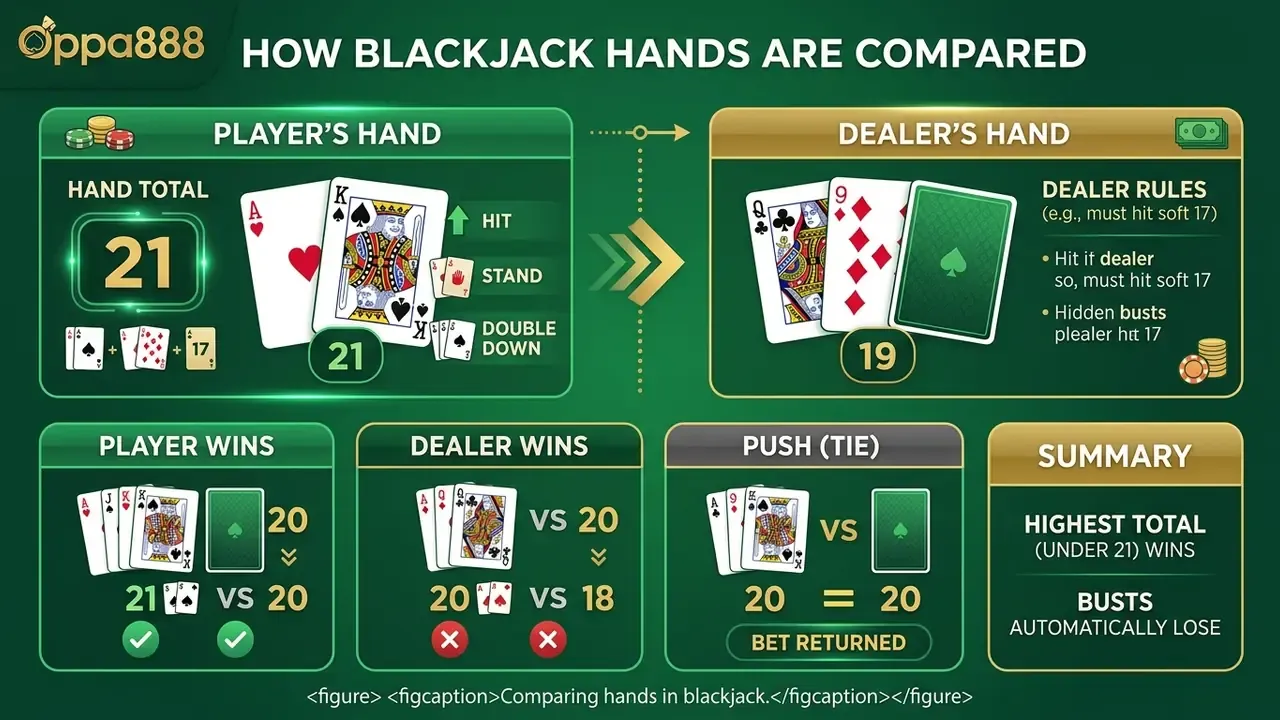
In a standard round, the player receives initial cards from a standard 52-card deck and decides whether to draw another card or hold the current total. If a player's hand exceeds 21 points, the hand busts and loses the bet immediately, whatever the dealer eventually holds. If the blackjack dealer busts while the player is still in the round, the player wins.
This is why "reach 21" is a misleading description of the objective. You can hold 20 and still lose to a dealer 21. You can hold 15 and win because the dealer busted. The dealer's hand, not the number 21, is your benchmark.
For readers who want the mathematics: modern decision theory treats every blackjack hand as a sequence of states with computable optimal actions.
«Blackjack is formalised as a Markov process in which the state encodes the player's total, the dealer's card, and the deck composition.» Source: Aparecido et al., Optimal Blackjack Betting Strategies Through Dynamic Programming, ScienceDirect (2025). https://www.sciencedirect.com
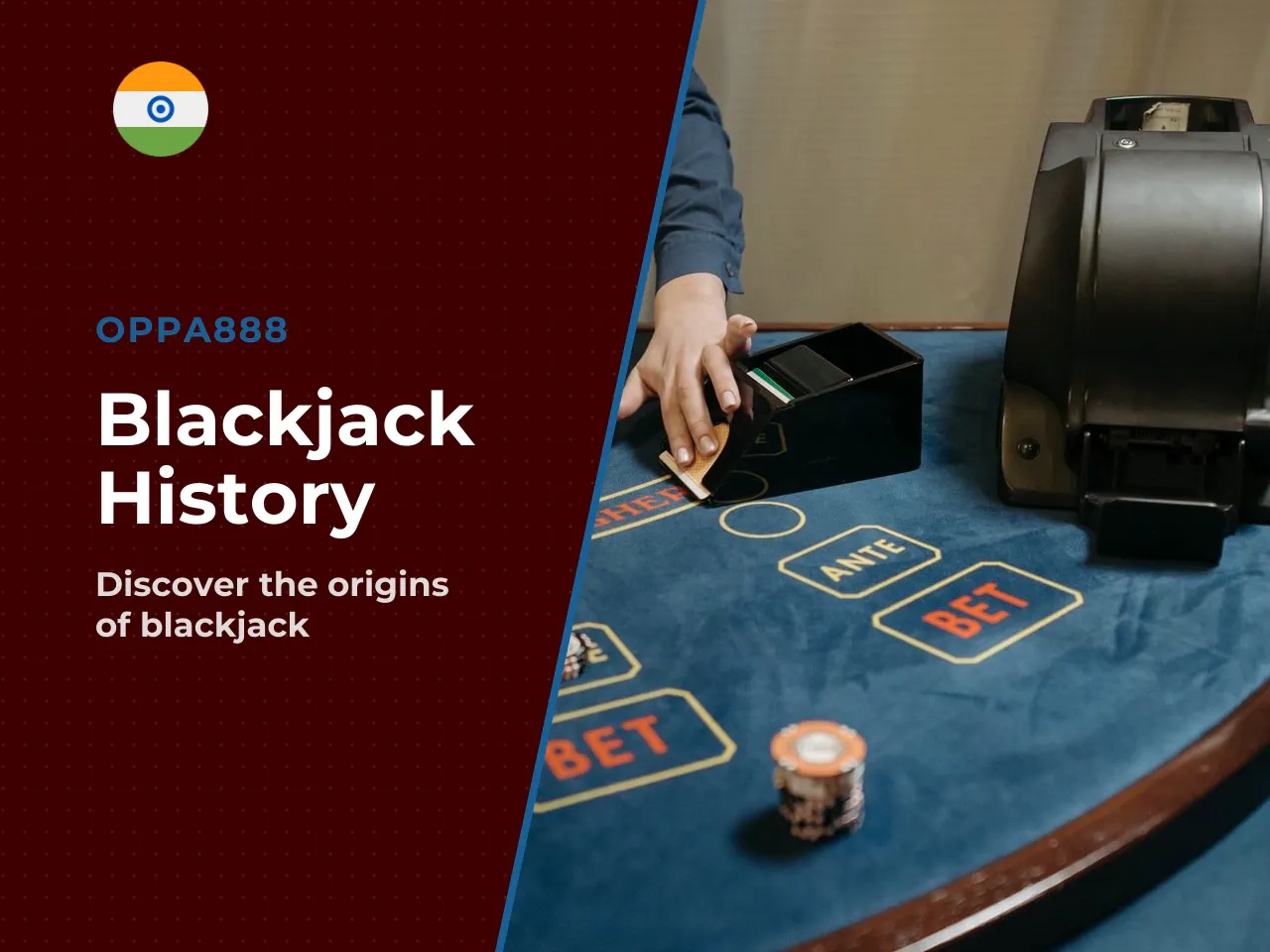
The game's direct ancestor is the French card game Vingt-et-Un ("Twenty-One"), documented in France in the early 1700s and carried to North America by settlers. The modern name has two competing explanations.
The popular version links it to an early American bonus payout of 10:1 for a hand of the Ace of Spades plus a black Jack (spades or clubs). A second hypothesis, argued by the French card historian Thierry Depaulis, connects the term to zinc blende, a mineral also known as "black-jack" and associated with silver and gold deposits. In that reading, twenty-one was a popular pastime during the Klondike Gold Rush, and prospectors borrowed the mining word for the two-card bonus hand. Both accounts remain hypotheses. No primary document settles the question either way.
A natural blackjack is the strongest opening combination, formed when a player receives an Ace alongside any ten-value card (10, Jack, Queen or King) on the first deal. The hand totals 21 immediately and closes the round for that position without any further action.
The real advantage sits in the payout. Under standard rules a natural blackjack pays 3:2, which is 1.5 times the original bet, while an ordinary win with a multi-card 21 pays only 1:1.
«The 3:2 payout for a natural blackjack is explicitly encoded in the MDP utility function as the highest reward among standard outcomes.» Source: Aparecido et al., Optimal Blackjack Betting Strategies Through Dynamic Programming, ScienceDirect (2025). https://www.sciencedirect.com
A natural also wins automatically unless the dealer gets blackjack too, in which case the hand is a push (tie) and your stake comes back. One detail beginners often miss: a 21 formed after a split counts as an ordinary 21 and pays 1:1, not 3:2.
The scoring system is refreshingly simple. Number cards from 2 through 9 hold their printed value. Ten-value cards, meaning the 10 and every card face (Jack, Queen, King), are worth 10 points each. Aces carry a dual value of 1 or 11.
A hand holding an Ace counted as 11 without exceeding 21 is a soft hand, for example Ace-6 as soft 17. If a further card would push a soft hand past 21, the Ace quietly reverts to 1 and the hand becomes a hard hand.
«A soft hand allows a safe draw: the Ace is re-counted as one point, preventing an immediate bust.» Source: Solowiej, Finding Blackjack's Optimal Strategy in Real-time and Player's Expected Win, arXiv (2024). https://arxiv.org
Understanding card values matters most in the two seconds after your first two cards are dealt, when the software is waiting for a decision.
Card values in blackjack and hand categories
| Card type / hand category | Point value | Scoring notes |
|---|---|---|
| Number cards (2–9) | 2 to 9 points | Counted strictly at printed face value. |
| Face cards (J, Q, K) and 10 | 10 points | Any card face counts as 10; paired with an Ace it forms a natural blackjack. |
| Ace | 1 or 11 points | Counts as 11 while the hand stays at or below 21, then drops to 1 to avoid a bust. |
| Soft hand | Variable (Ace = 11) | Allows a safe additional card, because the Ace can be revalued down to 1. Example: A-6 = soft 17. |
| Hard hand | Fixed (Ace = 1, or no Ace) | Any draw on totals of 12 or more carries direct bust risk. Example: A-7-9 = hard 17. |
In two sentences: Every round follows a fixed sequence of bet, deal, player decisions, dealer resolution, payout. The dealer has no discretion and must draw or stand according to the posted house rules.
A round of blackjack begins with players placing bets in the marked table boxes. Then two cards go to each active position and two to the dealer. Players read their totals against the dealer's upcard and act, and only after that does the dealer complete the hand under fixed rules.
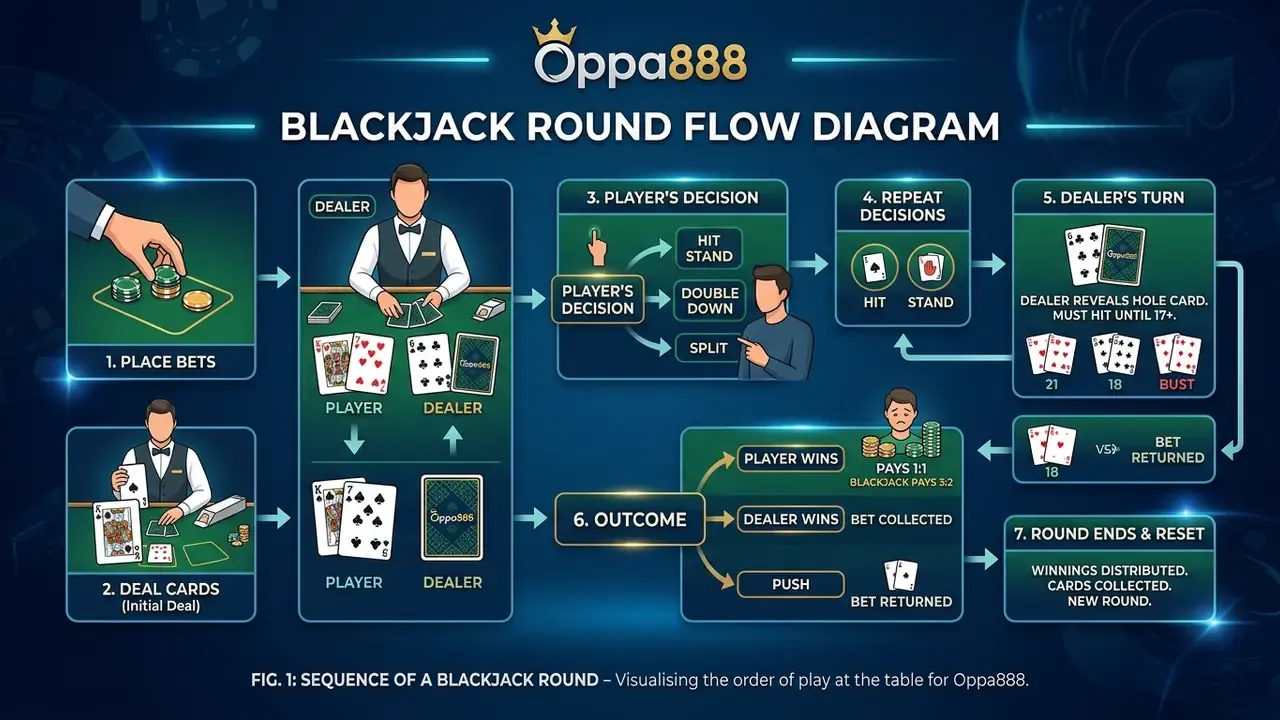
In Indian online casino lobbies, blackjack games load through desktop browsers or mobile apps, often in a dedicated "Table Games" or "Live Casino" tab. Before betting, check the table minimum and maximum so your stake size fits your entertainment budget rather than the other way round.
To join a round, place a bet with casino chips inside the posted table limits before dealing begins. A wager only counts once it sits in the betting spot and is confirmed. When bets lock, the blackjack dealer distributes two cards face-up to each player position and takes two for the house: normally one card face-up (the upcard) and one face-down (the hole card).
Your first card and second card together define every decision that follows, so read them as a pair, not one at a time. For users in India paying through UPI, NetBanking or wallets such as Paytm, managing a bankroll in Indian Rupees starts with the same discipline. Check limits before the deal. Once the initial bet is placed, the round's payout mechanics are fixed, and no amount of clever play changes them.
In a land-based casino, decisions are shown with gestures rather than spoken, because the table cameras need to verify every action. Live dealer online tables reproduce the same choices as on-screen buttons.
| Action | Hand signal in a land-based casino (face-up cards) | Online / live casino control |
|---|---|---|
| Hit (draw another card) | Tap or lightly scratch the felt beside your cards | "Hit" button / "+" |
| Stand (no more cards) | Wave your hand horizontally above the cards | "Stand" button / "✋" |
| Double Down | Place a second stack of chips beside the original bet and hold up one finger | "Double" button / "×2" |
| Split | Place matching chips beside the original bet and hold up two fingers ("V") | "Split" button / "✂️" |
| Surrender | Draw a horizontal line behind your bet with your index finger and say "surrender" | "Surrender" button (where offered) |
| Insurance | Place up to half your bet on the insurance line | "Insurance" prompt (timed) |
A few etiquette rules worth remembering: never touch the cards in a face-up shoe game, never touch your chips once the deal has started, and place cash on the felt instead of into the dealer's hand.
The dealer acts last, only after every player has stood, busted or doubled. The hole card is turned face-up, and then the dealer must draw according to mandatory house rules: hit on 16 or below, stand on 17 through 21. No judgement calls, no reading the table.
Some tables specify that the dealer hits on soft 17, an Ace-6 total. That variation nudges the house edge up compared with tables where the dealer stands on all 17s.
«Hitting on Soft 17 systematically increases the house advantage by altering the expected return of every available player action.» Source: Asad & Martin, Simplified Blackjack Variants, arXiv (2024). https://arxiv.org
If the dealer busts, every remaining active hand wins 1:1. If the dealer does not bust, totals closer to 21 win, lower totals lose, and identical totals push.
In two sentences: After the initial two cards you choose between six possible actions, depending on the table rules. Each choice measurably changes the expected mathematical return of the hand.
Having compared your two cards with the dealer's visible upcard, you can hit (draw another card), stand (keep the current hand), double down (double the bet for one final card), split (divide a matching pair), take insurance, or surrender. Small decisions, real consequences.
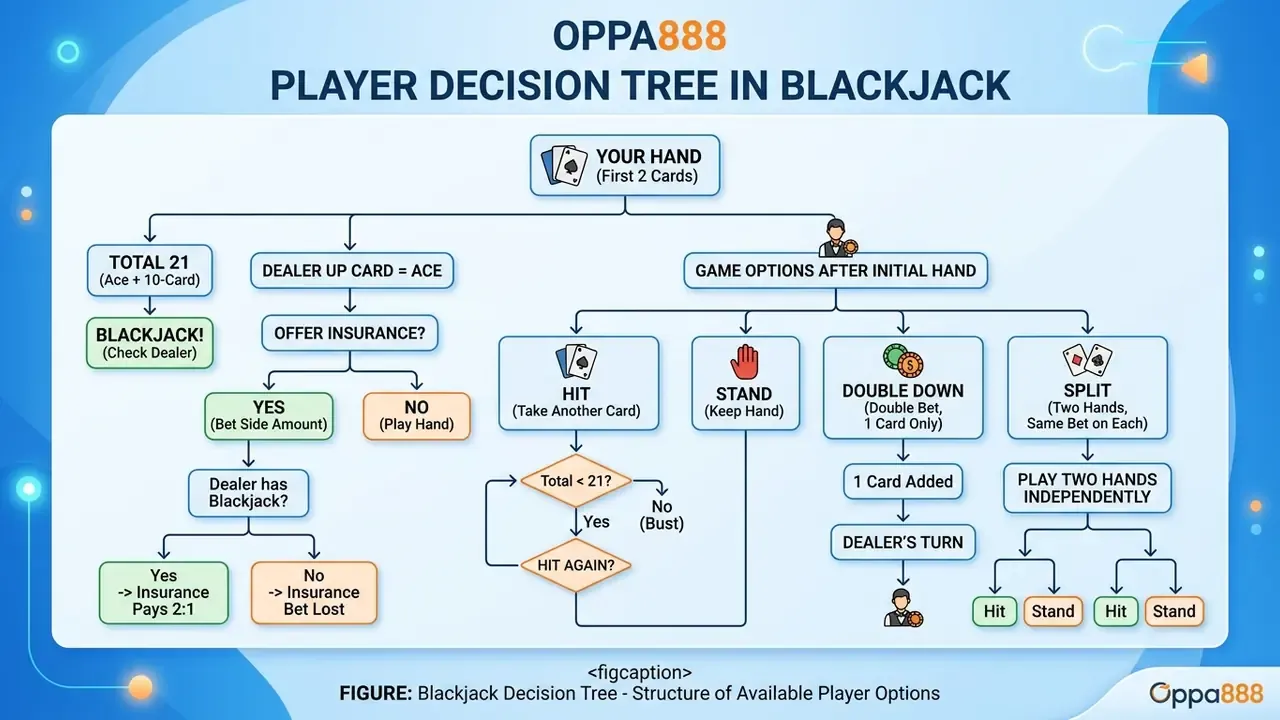
Hitting means asking for another card to raise your total. Standing locks the hand where it is. The choice balances your own bust risk against the dealer's chance of building a stronger total.
«Optimal standing against a weak dealer upcard follows from the conditional expected win computed for each player-total and dealer-card pair.» Source: Solowiej, Finding Blackjack's Optimal Strategy in Real-time and Player's Expected Win, arXiv (2024). https://arxiv.org
Standing on 16 against a dealer 6 feels wrong to almost everyone the first time. The maths disagrees with the instinct, and the maths is right.
These options let you press an advantage or cap a loss under narrow conditions:
Double Down: you double the initial bet and receive exactly one more card, then stand automatically. Mathematically strongest on hard 10 or 11 against a weak dealer upcard. Rule variations matter here: double after split lowers the house edge by roughly 0.14%, while restricting doubling to totals of 10 and 11 raises it by about 0.18%.
Split: if your two cards share a rank, such as two 8s or two Aces, you can add a wager equal to the original bet and play two separate hands. Basic strategy always splits Aces and 8s, and never splits tens, 5s or 4s, with the narrow exception of 4s against a dealer 5 or 6 where double after split is allowed. Split Aces usually receive one card each and no more.
Insurance: offered only when the dealer's upcard is an Ace. It is a side bet of up to half your original wager, paying 2:1 if the hole card is a ten-value card. Expected value is negative, roughly a 7.7% house edge in multi-deck games, so standard play declines it.
«The chance of a ten in the hole is about 30.8% with one deck, while insurance breaks even only at 33.3%: the bet is mathematically unprofitable.» Source: Solowiej, Finding Blackjack's Optimal Strategy in Real-time and Player's Expected Win, arXiv (2024). https://arxiv.org
Surrender (fold for half your bet): where offered, surrender abandons a weak hand before any draw and returns 50% of the stake. Two variants exist. Early surrender is available before the dealer checks for blackjack and favours the player, while late surrender applies only after the dealer confirms no blackjack and is far more common online. Correct use is narrow: surrender hard 16 against a dealer 9, 10 or Ace, and hard 15 against a dealer 10. Once you have hit, doubled or split, the option is normally gone.
In two sentences: Side bets are optional wagers settled independently of the main hand. They add volatility and carry a much higher house edge than the base game.
Beyond the main wager, most online blackjack tables, including First Person RNG titles and live studio tables, offer two standard extras:
You may also meet Any Pair, Bust It (the dealer busts) and Hot 3. The economics barely change between them. House edge on blackjack side bets typically runs from 3.2% to 7.1%, against roughly 0.5% on the main hand played with basic strategy. Because they resolve before or independently of your playing decisions, no adjustment improves them, which is exactly why basic strategy ignores them. Think of a side bet as a small entertainment expense you have consciously chosen, not a value play.
In two sentences: Online blackjack comes in three formats: free RNG demo, streamed live dealer tables, and real-money play. Your choice should follow your experience level and risk tolerance, not the size of a welcome offer.
Blackjack online is available in three operational shapes: RNG demo mode for free practice, live dealer streams for a studio atmosphere, and real money tables for actual wagering. The same rules apply across all three, but the pressure is not remotely the same.
For market context, blackjack is a comparatively niche online product despite its fame.
«Blackjack accounted for just 3.7% of UK online casino GGY (£161m) in 2023/24 while generating around 6% of turnover.» Source: UK Online Casino Games Market Analysis, igamingnuts (2023–2024).
That gap between turnover and gross gaming yield is what a low house edge looks like in aggregate data: heavy volume, thin operator margin.

Blackjack demo versions run on virtual credits, so you can play blackjack without spending anything or risking real money. Demo modes use a Random Number Generator (RNG) to simulate card distribution, which makes them a safe place to learn blackjack rules, test hit-or-stand choices, and drill a basic strategy chart.
For beginners in India, free play also answers duller but useful questions. Does the mobile interface respond quickly on your handset? Are the buttons large enough for a phone screen? Better to find out before registration or a first deposit.
Demo-mode starter checklist:
Blackjack live dealer formats stream a real human dealer at a physical table, broadcast in real time from a professional studio. Multi-camera HD feeds, a genuine card shoe and a shared table pace separate this format from RNG software, where a certified random number generator settles each hand instantly with no physical cards at all.
You place bets through a digital interface while watching cards dealt from the shoe. Blackjack live casino tables also add social layers: chat, side-bet statistics, and "Bet Behind" seats when a table is full. Convenient, though the tempo is set by other people, which is a real consideration for a beginner still learning the chart.
When judging live casino platforms for Indian players, stream stability on mobile data and a clearly displayed table payout are the primary quality markers. In our editorial review of live lobbies published in our iGaming format guide, mobile video optimisation, INR table availability and transparent withdrawal rules stood out as the benchmarks that actually affect user experience.
In two sentences: Basic strategy is a fixed lookup table showing the highest-expected-value action for every hand against every dealer upcard. Followed exactly, it sits close to the mathematical optimum for hand play.
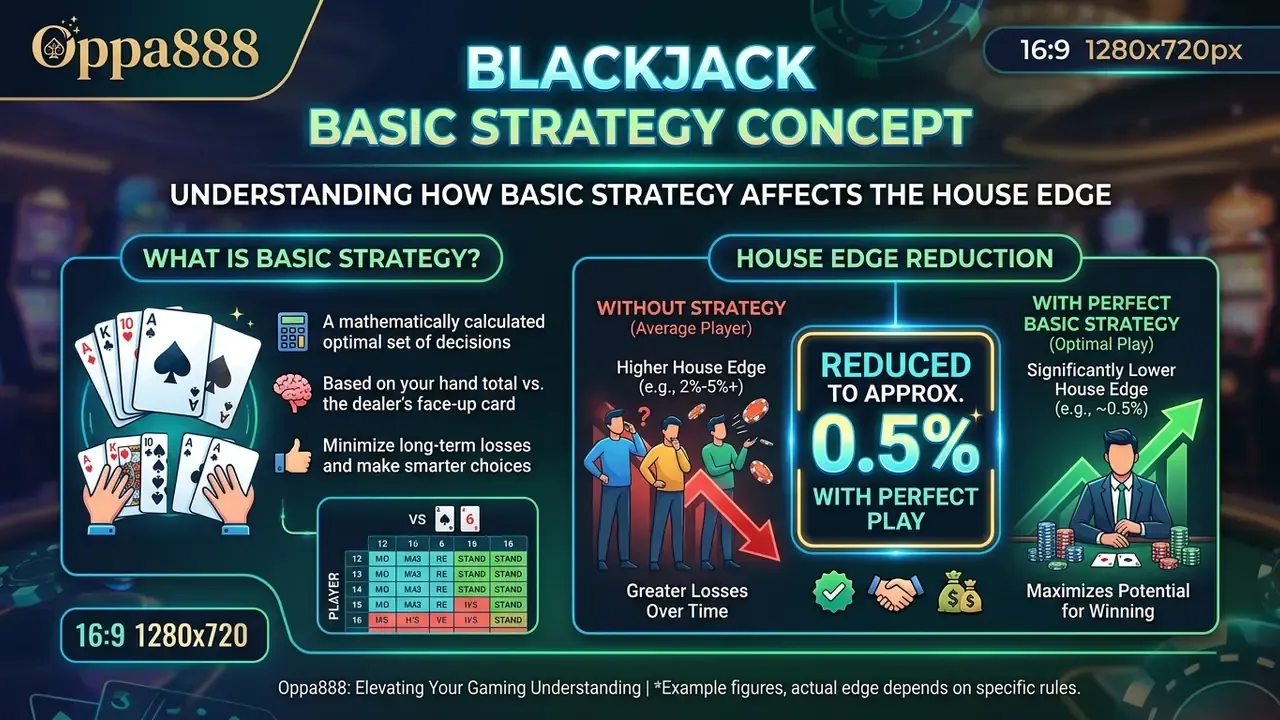
Blackjack strategy at this level is not intuition. It is a derived decision framework that prescribes the best action (hit, stand, double, split, surrender) for every combination of your hand and the dealer's upcard. Followed strictly, it pulls the house edge down to roughly 0.5% under standard multi-deck 3:2 rules, and published analyses put it as low as 0.16% on the most favourable rule sets.
«Optimised per-round policies yield only marginal gains over basic strategy, indicating that basic strategy already sits close to the global optimum.» Source: Aparecido et al., Optimal Blackjack Betting Strategies Through Dynamic Programming, ScienceDirect (2025). https://www.sciencedirect.com
Legend: H = Hit · S = Stand · D = Double if allowed, otherwise Hit · Ds = Double if allowed, otherwise Stand · SP = Split · SUR = Surrender if allowed, otherwise Hit
Hard totals
| Your hand | 2 | 3 | 4 | 5 | 6 | 7 | 8 | 9 | 10 | A |
|---|---|---|---|---|---|---|---|---|---|---|
| 8 or less | H | H | H | H | H | H | H | H | H | H |
| 9 | H | D | D | D | D | H | H | H | H | H |
| 10 | D | D | D | D | D | D | D | D | H | H |
| 11 | D | D | D | D | D | D | D | D | D | H |
| 12 | H | H | S | S | S | H | H | H | H | H |
| 13 | S | S | S | S | S | H | H | H | H | H |
| 14 | S | S | S | S | S | H | H | H | H | H |
| 15 | S | S | S | S | S | H | H | H | SUR | H |
| 16 | S | S | S | S | S | H | H | SUR | SUR | SUR |
| 17–21 | S | S | S | S | S | S | S | S | S | S |
Soft totals (hands containing an Ace counted as 11)
| Your hand | 2 | 3 | 4 | 5 | 6 | 7 | 8 | 9 | 10 | A |
|---|---|---|---|---|---|---|---|---|---|---|
| A,2 (soft 13) | H | H | H | D | D | H | H | H | H | H |
| A,3 (soft 14) | H | H | H | D | D | H | H | H | H | H |
| A,4 (soft 15) | H | H | D | D | D | H | H | H | H | H |
| A,5 (soft 16) | H | H | D | D | D | H | H | H | H | H |
| A,6 (soft 17) | H | D | D | D | D | H | H | H | H | H |
| A,7 (soft 18) | S | Ds | Ds | Ds | Ds | S | S | H | H | H |
| A,8 / A,9 | S | S | S | S | S | S | S | S | S | S |
Pairs (splitting decisions)
| Your pair | 2 | 3 | 4 | 5 | 6 | 7 | 8 | 9 | 10 | A |
|---|---|---|---|---|---|---|---|---|---|---|
| A,A | SP | SP | SP | SP | SP | SP | SP | SP | SP | SP |
| 10,10 | S | S | S | S | S | S | S | S | S | S |
| 9,9 | SP | SP | SP | SP | SP | S | SP | SP | S | S |
| 8,8 | SP | SP | SP | SP | SP | SP | SP | SP | SP | SP |
| 7,7 | SP | SP | SP | SP | SP | SP | H | H | H | H |
| 6,6 | SP | SP | SP | SP | SP | H | H | H | H | H |
| 5,5 | D | D | D | D | D | D | D | D | H | H |
| 4,4 | H | H | H | SP | SP | H | H | H | H | H |
| 3,3 | SP | SP | SP | SP | SP | SP | H | H | H | H |
| 2,2 | SP | SP | SP | SP | SP | SP | H | H | H | H |
Note: these decisions apply to 4 to 8 deck games where the dealer stands on all 17s and doubling after split is allowed. Where the dealer hits soft 17, a handful of cells change, for example double 11 against an Ace and surrender 15 against an Ace. Check the table rules first, every time.
Learn those four lines and you have covered most hands you will actually be dealt. The full matrix above handles the awkward remainder.
A chart tells you how to play a hand. It says nothing about how much to risk, and that is where most sessions go wrong.
Three habits help, and none of them require maths. First, decide your session budget in rupees before opening the lobby, and treat it as spent money, like a cinema ticket. Second, size bets so that one hand is a small fraction of that budget, ideally 1% to 2%, because doubles and splits can suddenly demand more than you planned. Third, set a stop point in both directions: a loss limit and a walk-away point when ahead.
Blackjack hands come fast online, sometimes 200 or more per hour on RNG tables. At that speed even a 0.5% edge grinds steadily, so time limits protect a bankroll just as much as bet sizing does. Slow down. It genuinely helps.
In two sentences: Card counting tracks the ratio of high to low cards left in a physical shoe. It is legitimate in land-based play but structurally neutralised in online blackjack.
Counting systems such as Hi-Lo assign values to cards as they are dealt: +1 to low cards 2 through 6, 0 to 7 through 9, and −1 to tens and Aces. Hi-Lo is a balanced system, so running it through a complete deck returns the count to zero.
From running count to true count
In multi-deck shoe games of 6 to 8 decks, adding +1/0/−1 is not enough. A running count of +6 means something very different with six decks left than with one. The conversion is simple:
True Count = Running Count ÷ Decks remaining in the shoe
Worked example: running count +6 with roughly 3 decks left gives a True Count of +2. At a True Count of +2 or higher the mathematical edge shifts toward the player by about 0.5%, and counters raise bet size proportionally while making a small number of strategy deviations. Insurance, for instance, turns into a positive-value bet at a True Count of +3 or higher.
Why none of this transfers online. RNG blackjack games reshuffle the virtual deck after every single hand, so probabilities reset before you can exploit them. On live dealer tables, operators run Continuous Shuffling Machines or cut the shoe frequently, and shallow penetration kills any sustained advantage.
«RNG blackjack reshuffles the deck after every hand, making counting impossible; live tables deploy continuous shuffling machines.» Source: PokerStars, How Casinos Detect Card Counters (2024). https://pokerstars.com
Counting is not illegal. It is also not a shortcut. Even in ideal land-based conditions it demands sustained concentration across long sessions to move the edge by a fraction of a percent, and venues retain the right to refuse service. If a website promises an online counting method that beats the house, treat that as a marketing claim, not information.
Fact Check: basic strategy optimises decisions to minimise the casino's mathematical edge, but it does not remove variance and it does not guarantee winning sessions. Every hand remains subject to probability, and short-term losses are normal no matter how well the chart is executed. Editorial Verification Team, Casino and Betting India
In two sentences: Blackjack is the game most heavily penalised in bonus terms, usually contributing only 0% to 10% toward wagering requirements. Accepting a bonus you intended to clear on blackjack is the fastest route to a blocked withdrawal.
Because basic strategy pushes the house edge close to 0.5%, operators protect themselves in the terms rather than at the table. Four clauses do most of the damage:
Practical rule: if you plan to play blackjack, decline the deposit bonus and play with cash only. A clean balance with no wagering attached is worth more than a nominal bonus you cannot convert. Where a bonus is unavoidable, screenshot the contribution table and the max-bet clause before your first hand. It takes ten seconds and it settles arguments later.
Disclaimer: this information is general and does not replace professional advice. Real-money play involves financial risk. 18+.
Starting out sensibly means three things: pick the format that matches your goal, verify the operator's licensing, and fix a budget before funding anything. Legal awareness, payment clarity and safety tools protect you from unverified platforms and predatory terms. This is also where perfect basic strategy becomes irrelevant, because no decision matrix helps on a platform that will not process a withdrawal. For a shortlist of operators we have reviewed for INR support and payout transparency, see our editorial coverage of verified online casinos.
There is a documented health dimension to format and frequency too.
«Among young men aged 18–24, online casino play, including blackjack, was significantly associated with problem gambling: χ² > 16, p < 0.001.» Source: Swiss cohort study on online gambling (2024).
Moving from demo credits to blackjack real money should happen only after four readiness checks:
If any of these is missing, staying in blackjack demo mode is simply the better call. There is no deadline.
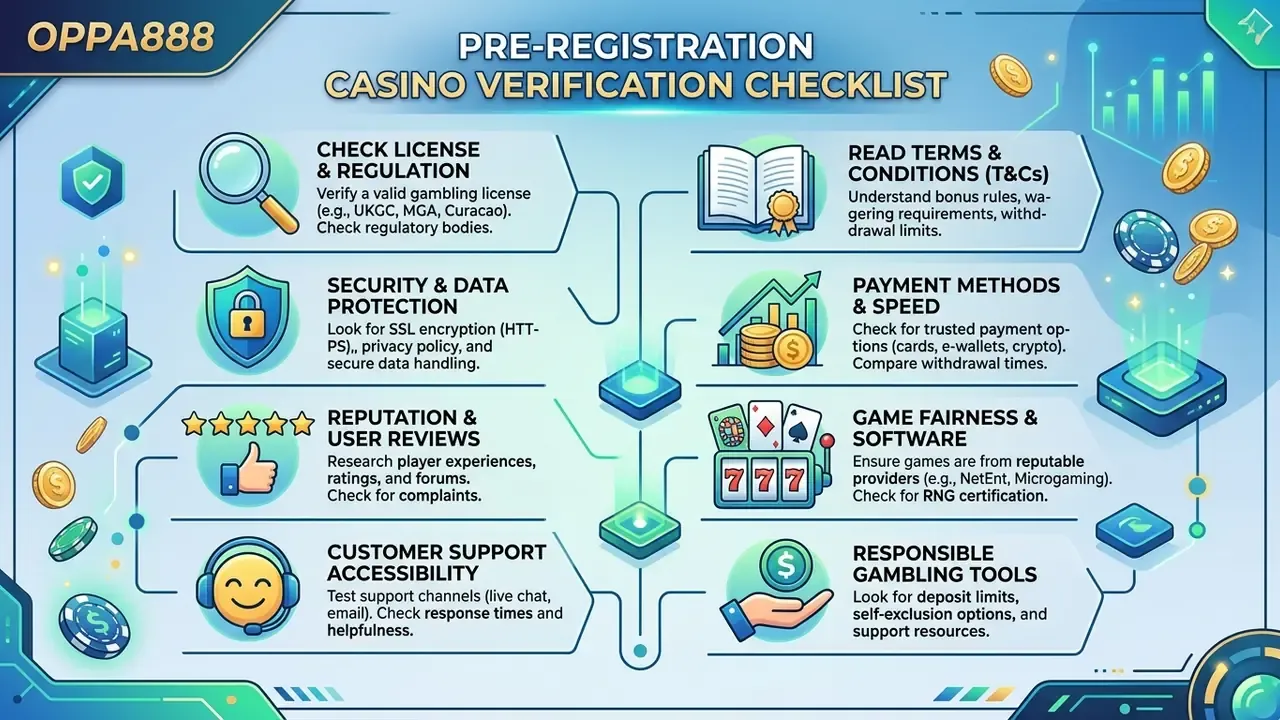
Before registering or depositing at any blackjack casino, work through these checks:
Licensing and regulation: verify the licence on the regulator's own register, not just the logo in the footer. Recognised authorities include the Malta Gaming Authority and Curaçao eGaming. Under India's evolving online gaming framework, including MeitY's rules on the promotion and regulation of online gaming, operators are expected to maintain transparent terms and functioning age verification (18+).
Table payout rules: confirm the blackjack tables pay 3:2 for naturals. Avoid 6:5 tables, since that rule adds more than 1.39% to the house edge.
«Changes to payout structure and dealer rules shift expected return and optimal strategy in a systematic, predictable direction.» Source: Asad & Martin, Simplified Blackjack Variants, arXiv (2024). https://arxiv.org
«Repeated in-session deposits and balance depletion are key behavioural predictors of self-reported problem gambling in AI-based models.» Source: Tóth et al., Using Artificial Intelligence Algorithms to Predict Self-Reported Problem Gambling (2024).
If you are topping up mid-session more than once, stop for the day. No exceptions worth arguing about.
This section is general information, not legal or tax advice. Verify the current position in your state and consult a qualified professional before depositing.
⚠️ Responsible gambling and financial risk. Real-money blackjack carries genuine financial risk. Winning is never guaranteed, and basic strategy cannot overcome the house edge over the long run. Set daily or monthly deposit limits, treat play strictly as entertainment, and never chase losses or gamble with money reserved for essential living expenses. If gambling stops feeling like entertainment, use self-exclusion tools and contact a support service. 18+ only.
About the author and review process. This guide comes from the Casino and Betting India editorial desk and was reviewed by Nisha Rao, Casino Content Editor, an editorial persona built around testing casino lobbies, table rule sets and INR payment flows for Indian users. Rule details here were checked against published regulator rule sheets, including AGCO, BCLC, the Nevada Gaming Control Board, the Washington State Gambling Commission and Singapore's Gambling Regulatory Authority, together with peer-reviewed and preprint mathematical analyses from 2024 to 2026.
Source changelog. An earlier version supported the "around 0.5% house edge" figure with a citation from a non-specialist domain. That reference has been replaced with Aparecido et al., Optimal Blackjack Betting Strategies Through Dynamic Programming, ScienceDirect (2025), which derives the result from a dynamic-programming model. Where a figure depends on rule configuration (deck count, dealer soft 17, double after split, surrender), we say so in the text instead of presenting one universal percentage.
Key sources referenced in this guide:
General disclaimer. This article is informational and educational. It is not legal, financial or tax advice, and it is not an inducement to gamble. Gambling involves the risk of financial loss and can be addictive. Real-money play is restricted to persons aged 18 or over, and 21 or over in some jurisdictions. Verify the legal status of online gambling in your state before depositing, and seek professional support if gambling is affecting your finances, work or relationships.
A safe next step. If you want to continue, start in demo mode, read the table rules panel, and set a deposit limit before anything else. That order is the whole point of this guide.