Oppa888
Dead or Alive Slot Review, Demo

Dead or Alive Slot: Review, Demo, RTP, and Real Money Play in India

Last updated: March 2026 · Reviewed by Nisha Rao, Content Editor at Casino and Betting India

Online slots differ far more than the lobby thumbnails suggest. Volatility, payout structure, and the maths under the reels change the experience completely. Dead or Alive, built by NetEnt back in 2009, is still the reference point for high-volatility Wild West slots, and it still confuses people who expect steady returns.

This guide explains how the game behaves in demo mode and in real money play. We break down the 9-line setup, the sticky wild free spins, the return-to-player (RTP) settings your casino may be hosting, hit frequency, bonus trigger odds, and the safety checks an Indian player should run before a first deposit. No income promises here. Just mechanics, numbers, and the catches.

Table of ContentCloseOpen
Quick Summary

Quick Summary

  • Game type:5×3 video slot, 9 fixed paylines, released 10 November 2009 by NetEnt.
  • RTP:96.82% default, but operators may host builds from 90.07% to 98.08%. Always verify inside the game's ? menu.
  • Volatility:High. Base game hit frequency: 30.00% (roughly 1 winning spin in 3.3), while the free spins round triggers only about once every 153 spins.
  • Max win:8,600x total stake per NetEnt's official specification. Legacy audits and older reviews quote up to 12,000x; some third-party sites quote 54,000x (clarified further down).
  • Bonus:12 free spins with a fixed 2x multiplier, Sticky Wilds, and a one-time +5 spin retrigger when sticky wilds cover all 5 reels.
  • Bonus Buy:Not available in the original Dead or Alive. Feature Buy (66.66x stake) exists only in Dead or Alive 2.
  • Demo:Available with virtual credits; identical rules, paytable, and certified game build.
  • India context:Check state-level legality, INR/UPI support, KYC name matching (PAN/Aadhaar), and bonus max-bet caps before depositing.

Dead or Alive Slot: Game Overview and Key Features

Dead or Alive is a 5-reel, 3-row video slot with 9 fixed paylines developed by NetEnt, running a default RTP of 96.82% and high volatility. The setting is a dusty 19th-century Western frontier. The payouts sit almost entirely inside the scatter-triggered bonus feature rather than in frequent base game wins, and that single fact shapes every session you will ever play on it.

FeatureSpecificationEditorial Check / Detail
DeveloperNetEntReleased November 10, 2009
Reel Grid5 reels × 3 rows9 fixed paylines (always active)
Default RTP96.82%Configurable range (90.07% to 98.08% depending on operator)
VolatilityHighExtended dry runs offset by high-payout bonus potential
Hit Frequency30.00%Roughly 1 winning combination every 3.3 base spins
Bonus Trigger Frequency≈1 in 153 spins (~0.65% per spin)3+ scatters required; no guaranteed interval
Max Win Potential8,600x total stake (official cap)Up to 12,000x in legacy payout audits; see the Max Win clarification
Min / Max Bet€0.09 / €18.00 per spinMinimum equals 9 coins at Level 1, not £0.90, which is a common third-party error
Special SymbolsWild (Wanted Poster), Scatter (Crossed Pistols)Wilds become sticky locked symbols in bonus play
Bonus Features12 Free Spins with 2x MultiplierRetrigger (+5 spins) when sticky wilds land on all 5 reels
Bonus Buy / Feature BuyNoAvailable only in Dead or Alive 2 at 66.66x total bet
PlatformsDesktop, Mobile (NetEnt Touch)Android, iOS, and responsive web browser compatible
Free Demo PlayAvailableRuns on virtual play credits with the identical certified game build
The mathematical engine isolates most of

The mathematical engine isolates most of the return inside the free spins. According to NetEnt's official Dead or Alive game page (netent.com/games/dead-or-alive), the slot runs a base game hit frequency of 30.00%, meaning about one spin in every 3.3 returns something. Many of those returns are smaller than the stake, which is a detail people skip. Landing 3 or more scatter symbols awards 12 free spins in which all line payouts are automatically doubled.

Community-tracked simulation data, combined with NetEnt's paytable structure, places average bonus entry at roughly one trigger every 153 to 160 spins. That is why bankroll planning matters more here than in low-variance slot games: at ₹9 per spin, a single average bonus cycle costs about ₹1,380 in turnover before the feature even appears. And averages say nothing about your individual session. Nothing at all.

Theme, Symbols, and Game Screen of

Theme, Symbols, and Game Screen of Dead or Alive

The visual design puts a Western saloon backdrop behind the reels, framed by stormy skies, a wooden gallows, and a slowly turning windmill. The audio does a lot of the work: desert wind, porch boards squeaking, creaking saloon floorboards, distant coyotes, and a gunshot when scatters land.

Symbols split into low-value card ranks and high-value Western paraphernalia:

  • Low-Value Symbols:10, J, Q, K, and A, rendered as metallic belt buckles and stone-carved lettering.
  • High-Value Symbols:whiskey glasses, cowboy boots with spurs, Stetson hats, gun holsters with belt cartridges, and a gold Sheriff star badge, the highest-paying standard symbol.
  • Wild Symbol:a "Wanted Outlaw" paper poster. It substitutes for all paying symbols except scatters.
  • Scatter Symbol:two crossed pearl-handled revolvers with bullets. Two scatters pay an instant coin prize; three or more open the bonus round.

During free spins the generic "Wanted" poster splits into five individual outlaw posters: Jesse James, Billy the Kid, Belle Starr, Della Rose, and Apache Kid. Each outlaw locks onto the specific reel where it appears, which is where the game gets its reputation.

How Dead or Alive Differs from

How Dead or Alive Differs from Other Slot Games

Dead or Alive sticks to a strict 9-line grid instead of a modern "Megaways" or "Cluster Pay" engine. Unlike multi-way slots with thousands of ways to win, every spin here needs matching symbols on fixed left-to-right line paths starting from reel 1. Old-school, and deliberately so.

The real point of difference is the sticky wild retrigger loop. When a wild lands during the 12 free spins, it stays locked in place for every remaining bonus spin. If at least one sticky wild sits on all 5 reels, the game immediately adds 5 more free spins. Because locked wilds accumulate across active paylines, payout potential grows steeply on the spins that follow.

«Realistic bonus features, sounds, animations, higher win frequency, significantly increase player preference for a free-spins slot, even when expected value is unchanged.» Taylor, Macaskill & Hunt, experimental slot-machine study (2017)

That finding explains part of the game's staying power. The visible, almost physical act of wilds nailing themselves to the reels delivers strong feedback long before any money is paid out. Newer titles like Wanted Dead or a Wild lean on duel multipliers; Dead or Alive keeps its legacy status through this transparent all-reel locking wild feature, and transparency is exactly why beginners can follow it.

Dead or Alive Franchise Evolution: DoA 1 vs DoA 2 vs DoA 3

Plenty of searches for "Dead or Alive slot" land on the wrong instalment. Use this timeline to confirm which game you actually opened:

VersionYearGrid / LinesBonus StructureMax WinFeature Buy
Dead or Alive20095×3 / 9 fixed lines12 free spins, fixed 2x multiplier, sticky wilds, +5 retrigger8,600x (12,000x in legacy audits)No
Dead or Alive 220195×3 / 9 fixed lines3 selectable modes: Train Heist, Old Saloon, High Noon Saloon111,111xYes, 66.66x total bet
Dead or Alive 3: Wanted20265×5 / 21 linesBounty Hunter expanding wilds, Wanted Wilds up to x100, Super Free Spins33,333x (66,666x with Elevate)Yes, Elevate options from 2x to 1,000x

If your casino lobby shows a 5×5 grid with 21 paylines and a 96.03% RTP, you are looking at Dead or Alive 3: Wanted (March 2026), not the 2009 classic reviewed here. If a "Buy Feature" button appears at 66.66x, you are inside Dead or Alive 2.

How to Play Dead or Alive Online

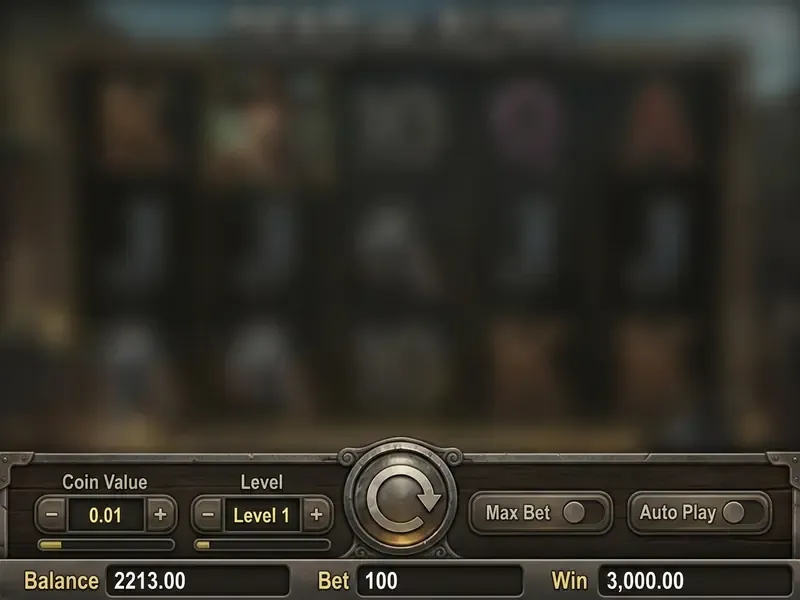
To play Dead or Alive online, set your total bet with the Level and Coin Value switches on the control panel, then press the central Spin button. Winning combinations need 3 or more matching symbols on an active payline, counted from left to right.

The interface gives you manual control

The interface gives you manual control over speed and betting parameters:

  1. Coin Value: sets the currency value of a single coin, typically from 0.01 to 0.50.
  2. Level: sets the number of coins wagered per line (Level 1 wagers 9 coins in total; Level 4 wagers 36 coins).
  3. Spin Button: runs a single round at the chosen stake.
  4. Max Bet: jumps straight to the maximum available bet level.
  5. Auto Play: programs automated spins, 10 to 1,000 rounds, with optional stop conditions for win limits or loss limits.
  6. Spanner Icon (Settings): toggles quick spin and spacebar spin shortcuts.
  7. Balance / Win Bar: Balance shows funds available for wagering; Win shows what came back in the current round.

Auto Play with a loss limit set is, honestly, the single most underused button on that panel.

Bet, Spin, and Game Round. Every

Bet, Spin, and Game Round

Every game round follows a fixed calculation for the total stake per spin. Since all 9 paylines are permanently active, the formula is simple:

Total Stake = Coin Value × Bet Level × 9 lines

For example, a Coin Value of ₹1.00 (or $0.01) at Bet Level 1 gives a total stake of ₹9.00 ($0.09) per spin. Raise the Bet Level to 2 and the stake doubles to ₹18.00 ($0.18). At Level 4 with a ₹1.00 coin value, one spin costs ₹36.00. This is also why some review sites print "£0.90 minimum bet" by mistake. The true floor is 9 coins, which is £0.09 at the smallest coin denomination.

When a spin ends, the internal Random Number Generator (RNG) stops the reels. Line payouts evaluate strictly from left to right. Only the highest winning combination per line pays, though wins on different paylines in the same round add together. Scatters pay from any position, independent of paylines, and scatter wins multiply the total bet rather than the per-line bet.

Dead or Alive Demo Launching Without

Dead or Alive Demo: Launching Without Real Money

Dead or Alive demo mode lets you test the game on virtual play credits with no money at risk. The dead or alive free version loads the same certified game build as the real money release: identical reel strips, symbol distributions, paytable values, and RNG logic.

In our editorial comparison of demo and real money lobbies at licensed operators, we found no differences in declared rules, paytable values, bet formula, or bonus trigger conditions between the two modes. Let me be precise about the limits of that check, because it matters: we compared help files, paytables, and interface behaviour. It was not an independent RNG certification, and we make no statistical claim about measured hit frequency in demo builds.

RNG independence itself is confirmed by third-party testing houses as part of NetEnt's licensing obligations.

Situation: An Indian user wants to test Dead or Alive volatility without financial exposure.
Action: The user launches the official demo mode, running 200 virtual spins at 9 coins per spin.
Result: The user observes extended sequences of non-winning spins, experiencing the game's high variance before deciding whether to deposit real funds.

Demo play is a practical learning tool, but the academic literature on simulated gambling flags a psychological cost. The 2017 study by Taylor, Macaskill and Hunt on slot feature preferences showed that realistic bonus animations and frequent free-spin feedback raise engagement regardless of whether real money is on the table. Research on simulated gambling is blunter about the downside:

«Participation in simulated casino-style games is associated with an elevated risk of harmful gaming and problem gambling in adults.» Representative study on simulated gambling (2024)

Two practical consequences follow. First, a lucky demo run can build an expectation of bonus timing that the RNG does not owe you once you switch to cash play. Second, use demo mode only to judge interface mechanics and the volatility profile, never to "warm up" or test a betting system. There is no system to test.

Quick Glossary for First-Time Slot Players

Quick Glossary for First-Time Slot Players

Terms get thrown around fast in slot reviews, so here is the short version:
  • RTP:theoretical long-term return across millions of spins, not a session forecast.
  • Volatility (variance):how unevenly the payouts arrive. High volatility means rarer wins and bigger swings.
  • Hit frequency:share of spins that return anything, including amounts smaller than your stake.
  • Wild:a symbol that stands in for other paying symbols. Here it is the Wanted poster.
  • Scatter:pays from any position and can open the free spins feature.
  • Sticky wild:a wild that locks in place for the rest of the bonus round.
  • Retrigger:extra free spins awarded inside an active feature.
  • Wagering requirement:how much turnover a bonus needs before withdrawal becomes possible.
  • LDW (loss disguised as a win):a payout smaller than your stake, celebrated with sound and animation.

Wild, Multiplier, and Free Spins in Dead or Alive

The payout engine in Dead or Alive rests on three pillars: base game Wilds, Scatter payouts, and the Free Spins feature with its 2x win multiplier and sticky wild locks.

Wild and Multiplier in the Base

Wild and Multiplier in the Base Game

In the base game, the Wanted poster Wild substitutes for all standard symbols to complete 3, 4, or 5-symbol payline combinations. It does not substitute for the crossed pistol scatters, and no scatter symbols appear on the reels during free spins at all.

Base game line payouts for Wild combinations follow the paytable values, multiplied by the line bet:

  • 3 Wilds on a payline:50 coins
  • 4 Wilds on a payline:300 coins
  • 5 Wilds on a payline:1,500 coins

There is no standalone multiplier on base game Wild substitutions. Multipliers in this slot live exclusively inside the free spins round.

Free Spins Feature and Bonus Round

Landing 3, 4, or 5 Scatter symbols anywhere on the reels during one base spin activates the Free Spins feature and awards 12 free spins.

The bonus round runs on three

The bonus round runs on three rules:

  1. 2x Multiplier: every winning payline combination formed during free spins is multiplied by 2.
  2. Sticky Wilds: any Wild that lands during free spins turns into a Wanted poster outlaw and locks onto that exact reel position for all remaining spins. Sticky wilds do not carry into the base game once the feature ends, and every new feature starts with an empty grid.
  3. Retrigger (+5 Extra Spins): if one or more Sticky Wilds sit on all 5 reels during the feature, the game adds 5 free spins. This retrigger happens once per bonus round, and the retriggered spins keep every sticky wild already collected.

Scatters also pay upfront, before the free spins begin:

Oppa888 heading-banner
  • 2 Scatters:2x total bet (no free spins)
  • 3 Scatters:4x total bet + 12 Free Spins
  • 4 Scatters:25x total bet + 12 Free Spins
  • 5 Scatters:2,500x total bet + 12 Free Spins

The 2,500x scatter payout for five revolvers is among the largest single-spin scatter awards in NetEnt's classic 9-line catalogue. NetEnt's published paytable confirms the 2,500x figure. We found no provider-published ranking that formally compares scatter payouts across the full NetEnt library, so treat "largest" as an editorial observation, not a certified statistic.

Dead or Alive Bonus Buy Does

Dead or Alive Bonus Buy: Does the Feature Exist?

The original Dead or Alive (2009) has no Bonus Buy option. You cannot pay an upfront fee to jump into the free spins; the bonus only opens when 3 or more scatters land during normal base game play. If you are scanning the screen for a "Buy Feature" button, you will not find one, and any site claiming otherwise for DoA 1 is describing a different game.

Feature buy arrived with the sequel, Dead or Alive 2 (Feature Buy), where entry into the free spins round costs 66.66x the total bet. At a ₹10 total stake, that purchase costs ₹666.60. Dead or Alive 3: Wanted (2026) pushes further with tiered "Elevate" purchases from 2x up to 1,000x the stake.

How should you evaluate a bonus buy before pressing it? Three checks. First, buying a feature does not improve long-term RTP or remove the house edge: on the 96.82% build, the edge stays at 3.18% per wager whether you buy or spin.

Second, it compresses variance into a very short window, so financial swings get sharper, not softer. Third, confirm the price in your own currency before you click, because 66.66x looks small as a multiplier and large in rupees. Buying several features back to back can empty an entertainment budget in minutes if the sticky wilds fail to connect high-value outlaw combinations.

RTP, Max Win, and Potential Payouts in Dead or Alive

Dead or Alive carries a default technical Return to Player (RTP) of 96.82% alongside high volatility. RTP is a mathematical long-term average over millions of theoretical spins. It is not a promise about your session, your evening, or your first 100 spins.

Fact Check and Risk Notice: the Maths of Slot Outcomes RTP figures below are informational. Actual session results can deviate substantially from theoretical values, and gambling carries a risk of financial loss.

  • RTP is a theoretical average: a 96.82% RTP means the game keeps an average house edge of 3.18% over millions of spins. Across a short 100-spin session, your actual return can land anywhere from 0% to several thousand percent of your wagers.
  • Seven variable RTP configurations: NetEnt supplies Dead or Alive in multiple operator-configurable builds, specifically 98.08%, 96.82%, 95.03%, 94.03%, 93.06%, 92.06%, and 90.07%. Operators choose which version to host, and one large UK-facing casino publicly lists 92.06%. Open the game help file (? icon) at your casino to verify the active RTP before your first spin.
  • Hit frequency vs bonus frequency: a 30.00% hit frequency does not mean 30% of spins are profitable. It counts any payout, including sub-stake returns. The feature that carries the game's payout weight arrives roughly once per 153 spins.
  • RNG independence: outcomes come from a certified Random Number Generator. Past non-winning spins do not raise the probability of a win on the next one.
  • Losses disguised as wins (LDWs): payouts smaller than your total stake, say ₹2.00 back on a ₹9.00 spin, are net losses despite the celebration on screen.
  • Sources: NetEnt official game specification; Palomäki, Kunnari & Laakasuo (2024); Myles et al. (2023).
Max Win Clarification 8,600x, 12,000x, or

Max Win Clarification: 8,600x, 12,000x, or 54,000x?

Published max win figures for this slot contradict each other, and the gap matters when you size a bankroll:

  • 8,600x total stake is the figure in NetEnt's current official game specification. Treat this as the reference number.
  • 12,000x total stake appears in legacy payout audits and older review databases. It reflects an earlier payout-potential calculation for the same title and is still widely reproduced.
  • 54,000x total stake is quoted by several casino affiliates and operator pages. This is not an official NetEnt cap. It describes a theoretical ceiling: five Sticky Wilds locking into the highest-paying arrangement early in the feature, with maximum line combinations connecting across all 17 available free spins (12 plus the 5-spin retrigger) under the 2x multiplier. The probability of that sequence is vanishingly small, and no operator guarantees it.

Practical takeaway: plan around 8,600x as the documented ceiling, read 54,000x as a mathematical extreme rather than an expectation, and check the paytable in your own casino build. A 90.07% RTP version changes the entire payout distribution, quietly.

Why LDWs Distort Perception

Palomäki, Kunnari and Laakasuo (2024) argue that the way RTP is normally described feeds the gambler's fallacy, the belief that a game is "due" after a run of losing spins.

«Standard RTP definitions are mathematically incorrect: random sequences do not self-correct, and no individual player can expect to receive back any specific amount.» Palomäki, Kunnari & Laakasuo (2024), critical analysis of RTP framing

Experimental research published in 2025 under the title "Never tell me the odds" went further. Showing generic RTP percentages raised players' perceived chances of winning by an odds ratio above 5, while the real statistical odds did not move at all.

«Participants shown a standard "RTP 90%" message rated their chances of winning significantly higher than the control group, with identical real probabilities.» "Never tell me the odds" (2025), randomised experiment across two jurisdictions

The sub-stake payout problem stacks on top of that. Experimental work quantifies how badly players read those outcomes:

«Only about 38% of participants correctly interpreted a loss disguised as a win as a loss; most systematically overestimated how many times they had won.» Myles et al. (2023), online experiment, n=940 Australian adults

Neurophysiological data points the same direction:

«LDW events elicit a more positive neural response (reward positivity ERP) than plain losses, functioning as pseudo-rewards that reinforce continued play.» Psychophysiological slot-machine study (2024), EEG experiment

So treat RTP as an indicator of long-term house edge, never as a cashout metric. And read the Balance figure rather than the animation when you want to know whether a spin actually made money. The balance never exaggerates.

Dead or Alive Real Money: What to Check Before Playing at a Casino

Legal disclaimer: this information is general in nature and does not replace legal advice. Online gambling legislation varies by state and jurisdiction. Verify the current rules in your region before registering or depositing.

"Before you deposit at any online casino, verify the exact withdrawal terms and the game's RTP version. A massive headline bonus loses value if withdrawal limits or heavy wagering terms block your payouts." Nisha Rao, Content Editor at Casino and Betting India

Before playing Dead or Alive for

Before playing Dead or Alive for real money, an Indian user should verify four things: the operator's licence, the hosted RTP build, the withdrawal terms, and payment options that work with local accounts such as UPI, NetBanking, or IMPS. Our editorial work on online casinos for Indian players is built around exactly those four checks, because they decide whether winnings ever leave the platform.

[INTERACTIVE CHECKLIST: Casino Verification Before Real Money Play]
Description: Interactive 5-point checklist for evaluating online casinos hosting Dead or Alive.
1. Active Licence Check: is the operator verified via MGA, UKGC, or Curacao eGaming registers?
2. Game Build Check: does the game load directly from NetEnt servers with 96.82% RTP?
3. Payment Compatibility: are INR deposits and withdrawals supported via local UPI/NetBanking?
4. Bonus Term Check: is Dead or Alive restricted from bonus wagering, or capped on max bets?
5. Account Verification (KYC): are withdrawal limits and ID verification rules clearly stated?
Purpose: Helps users screen platforms and avoid unsafe deposits.
Semantics: section with checkable list items, all fully readable as plain text in the DOM without JavaScript.

Payment processing rules deserve a concrete example, because this is where Indian players most often get stuck.

In our analysis of withdrawal requests on India-facing platforms, one recurring verification issue stood out: bank name mismatches triggering UPI payout rejections. In the case we tracked, updating the profile details to match the bank passbook exactly, before submitting KYC documents, cleared the block and the withdrawal completed within 24 hours. A spelling difference of two letters had held it up.

When you compare operators, look closely at payments and legal context:

Oppa888 heading-banner
  • Payment friction:confirm the operator supports direct INR transactions through UPI, Paytm, PhonePe, or NetBanking, so you avoid cross-border conversion fees.
  • Legal and regulatory context:in India, real-money gaming faces strict legal scrutiny under the Promotion and Regulation of Online Gaming Act 2025 and Rules 2026, and availability varies by state. Several states, among them Telangana, Andhra Pradesh, Assam, Odisha, Nagaland, and Sikkim, have historically applied their own restrictions or licensing regimes to online real-money games. A platform reachable from Mumbai may be prohibited or blocked for a user in Hyderabad. Check your state law and the platform's compliance status before registration.
  • Identity verification (KYC):regulated casinos ask for PAN card, Aadhaar, or a utility bill before processing a first withdrawal. Your registered casino name must match your bank account name exactly.

Behavioural monitoring is now a standard part of licensed operations, not an optional extra:

«Machine-learning models trained on player-tracking data predict problem gambling effectively; the strongest predictors are deposit frequency, total daily wagers, and session length.» Problem-gambling prediction study (2025), machine learning on player-tracking data

If a licensed operator contacts you about deposit frequency or session length, read that message carefully instead of dismissing it. It is a compliance signal, and sometimes a useful one.

Red Flags When to Close the

Red Flags: When to Close the Tab

Some warning signs are worth acting on immediately, before any deposit:

  • No verifiable licence number, or a register entry that does not match the site's operating company.
  • "Guaranteed win" or "income" language anywhere in the promotional copy.
  • Withdrawal terms that appear only after registration, or T&Cs hidden behind a login.
  • A game build with no visible RTP in the help panel, or a lobby copy of Dead or Alive that does not load from provider servers.
  • Support that cannot answer a plain question about payout timelines in writing.
  • Pressure tactics: countdown timers on deposit pages, repeated bonus pop-ups, or offers that expire in minutes.

Any two of these together is usually enough reason to walk away and look elsewhere.

UPI Transaction Checklist for Indian Players

StepWhat to verifyWhy it matters
1. VPA and limitsConfirm your UPI handle is active and check per-transaction and daily bank limitsCasino deposits above your bank's UPI ceiling silently fail
2. Name matchCasino profile name = bank passbook name = PAN card nameThe single most common cause of rejected payouts
3. Method symmetryCheck whether withdrawals return to the same UPI/NetBanking channel used for the depositMany operators enforce closed-loop payouts
4. Pending paymentIf UPI debits but the casino balance does not update, save the UTR reference number and raise a ticket the same dayUTR is the only proof processors accept
5. Payout timingNote the stated processing windows, often 24 to 72 hours after KYC clearsPrevents duplicate withdrawal requests being cancelled
6. FeesCheck for conversion or processing fees on INR withdrawalsCross-border conversion can erode small payouts
Casino Bonuses and Terms of Use

Casino Bonuses and Terms of Use

Promotional offers such as welcome deposit matches usually carry restrictive terms when applied to a high-volatility slot like this one:

  1. High wagering requirements: bonus funds typically need 30x to 50x turnover before withdrawal. High-variance slots can drain a bonus balance long before wagering completes.
  2. Game exclusions: because of the payout potential, many casinos exclude Dead or Alive (and its sequel) from contributing 100% toward wagering, or cap the contribution at 10% to 20%.
  3. Maximum bet caps: during active bonus play, operators enforce max bet limits, commonly ₹400, €5, or £2 per spin. One spin above the cap can forfeit all bonus winnings.
  4. Maximum cashout limits: some free spin promotions cap total withdrawable winnings at a fixed amount, for example ₹5,000.

Worked wagering example in INR. Say you deposit ₹1,000 and take a 100% match bonus of ₹1,000 with 35x wagering on deposit plus bonus:

  • Required turnover = (₹1,000 + ₹1,000) × 35 = ₹70,000.
  • At ₹9 per spin, that is roughly 7,780 spins.
  • If Dead or Alive contributes only 20% toward wagering, the effective requirement climbs to about ₹350,000 of turnover on this slot alone, close to 38,900 spins.
  • With a bonus trigger roughly every 153 spins, you would statistically pass through 50 or more bonus rounds before clearing the requirement. Every dry stretch in between is funded from a ₹2,000 combined balance, in a game where one feature gap can swallow 150 spins of budget.

That arithmetic is exactly why high-variance slots and large wagering requirements combine so poorly. The maths does not forbid clearing the bonus. The bankroll simply tends to run out first. Read the operator's terms specifically for "Excluded Games", "Contribution Rates", and "Max Bet Rules" before you claim anything.

Dead or Alive Mobile Playing from

Dead or Alive Mobile: Playing from a Smartphone

Dead or Alive mobile runs on NetEnt's Touch interface, built for HTML5 browsers on Android and iOS. The grid, paytable, and RTP parameters match the desktop version exactly.
  • Interface adaptation:the spin button moves to the right side of the screen, while bet parameters fold into a slide-out drawer to keep the grid visible.
  • System requirements:Android 8.0+ or iOS 13.0+ with at least 2 GB RAM (3 GB on Android) and a stable 4G/5G or Wi-Fi connection.
  • Data consumption:roughly 120 MB to 180 MB per hour of continuous play, worth checking against a metered mobile plan.
  • Connection stability:the game needs a live connection. Interrupted rounds resolve server-side, and an unfinished round is normally restored at your next login.

Mobile access sits beside a second exposure channel that deserves naming:

«Watching slot streams is associated with higher intention to gamble for money in the future, according to a Theory of Planned Behaviour model.» Study on gambling streaming and intention (2024)

Big-win clips of sticky-wild sessions circulate heavily on streaming platforms. Those clips are selected outcomes, not representative sessions, and they leave out the hundreds of spins that paid for them.

Regulatory Information and Responsible Gambling Disclaimer

  • Game provider licensing: NetEnt operates under licences issued by the Malta Gaming Authority, the UK Gambling Commission, the Gibraltar Gambling Commissioner, the Alderney Gambling Control Commission, ONJN (Romania), DGOJ (Spain), and Pennsylvania regulators.
  • Age restrictions: real money casino play is restricted to individuals aged 18+, or 21+ depending on the regional jurisdiction, for example New Jersey.
  • Responsible gambling: casino games are paid entertainment, not income sources or financial investments. Set deposit and loss limits before playing. If you feel control slipping, use self-exclusion tools, reality checks, or contact support services such as NIMHANS or a local helpline.
  • Sources: NetEnt licence information and Responsible Gaming pages; UKGC Regulatory Framework.
Who Dead or Alive Slot Suits

Who Dead or Alive Slot Suits Best

The game fits a fairly narrow player profile, and pretending otherwise would be unfair:

  • Suitable for: experienced slot players who understand high volatility, accept long non-winning sequences, and are drawn to a high-multiplier bonus feature.
  • Not ideal for: casual players hunting frequent small wins, users with small bankrolls, or anyone who wants low-risk entertainment.
[COMPARISON SCHEME: Player Archetype vs Game Volatility Match]
Description: Side-by-side comparison chart matching bankroll types and player goals against Dead or Alive's high volatility engine.
Purpose: Guides users on whether Dead or Alive aligns with their playing preferences.
Semantics: figure block with a caption listing suitable and unsuitable player profiles in plain text.

Practical guidance by experience level:

  • Newcomers: start in demo mode, then move to the ₹9 minimum stake, and expect the bonus round to be rare rather than routine. Never raise stakes to "catch up" after a dry run. The RNG has no memory of your losses.
  • Experienced high-variance players: size a session bankroll for at least 300 to 500 spins at your chosen stake, so an average bonus gap does not end the session early, and confirm the RTP build before committing volume.

Dead or Alive vs Other Wild West Slots

Like the theme but want different mechanics, or a shorter wait between bonus rounds? These are the closest alternatives in the genre:

Slot TitleProviderGrid / PaylinesVolatilityMax WinKey Feature
Dead or AliveNetEnt5×3 / 9 linesHigh8,600x2x multiplier plus retriggering Sticky Wilds
Dead or Alive 2NetEnt5×3 / 9 linesVery High111,111xThree selectable bonus modes; Feature Buy 66.66x
Dead or Alive 3: WantedNetEnt5×5 / 21 linesHigh33,333x (66,666x Elevate)Bounty Hunter expanding wilds, multipliers to x100
DeadwoodNolimit City3-4-4-4-3 / 576 waysExtreme13,950xxNudge multiplier wilds, Shoot Out bonus, 3 free-spin modes
Wanted Dead or a WildHacksaw Gaming5×5 / 15 linesHigh10,000xDuel/VS multiplier reels up to 100x
Mega Fire Blaze Wild PistoleroPlaytech / Rarestone5×3 / 30 linesMedium-High2,000xRespin lock and accumulator bonus

Read that table as a trade-off map. Dead or Alive gives you the simplest ruleset and the clearest bonus logic. Deadwood and Wanted Dead or a Wild swap simplicity for multiplier depth and extreme variance. Wild Pistolero lowers the ceiling in exchange for more frequent feature action, which suits smaller budgets better.

FAQ: Dead or Alive Slot

Final Verdict and Responsible Action Steps

Dead or Alive still stands out in NetEnt's portfolio: simple 9-line mechanics, a transparent 30.00% hit frequency, and sticky wild free spins that continue to define the Wild West genre seventeen years after release. The trade-offs are equally clear. High volatility, a rare bonus entry around 1 in 153 spins, and operator-configurable RTP all demand bankroll discipline and honest risk awareness. Want a higher ceiling? Look at Dead or Alive 2. Prefer modern multiplier mechanics? Deadwood or Wanted Dead or a Wild will feel closer to your taste.

Before taking any action:

1
Try the demo version first, to feel the variance without financial exposure.
2
Check the casino's game info panel and confirm the active RTP build. Look for 96.82%, and walk away from 90.07% builds.
3
Verify that the platform offers INR-friendly deposit and withdrawal methods, with clear KYC policies and exact name matching across PAN, Aadhaar, and bank records.
4
Confirm your state's legal position on online real-money gaming before registering.
5
Read the bonus contribution rate and max bet cap before claiming an offer, and run the turnover maths in rupees.
6
Set personal deposit, loss, and time limits before your first spin.
Gambling involves financial risk and is intended as paid entertainment, not income. Players must be 18+, or 21+ in some jurisdictions. If gambling stops feeling like entertainment, use deposit limits, reality checks, or self-exclusion tools, and contact a professional support service.